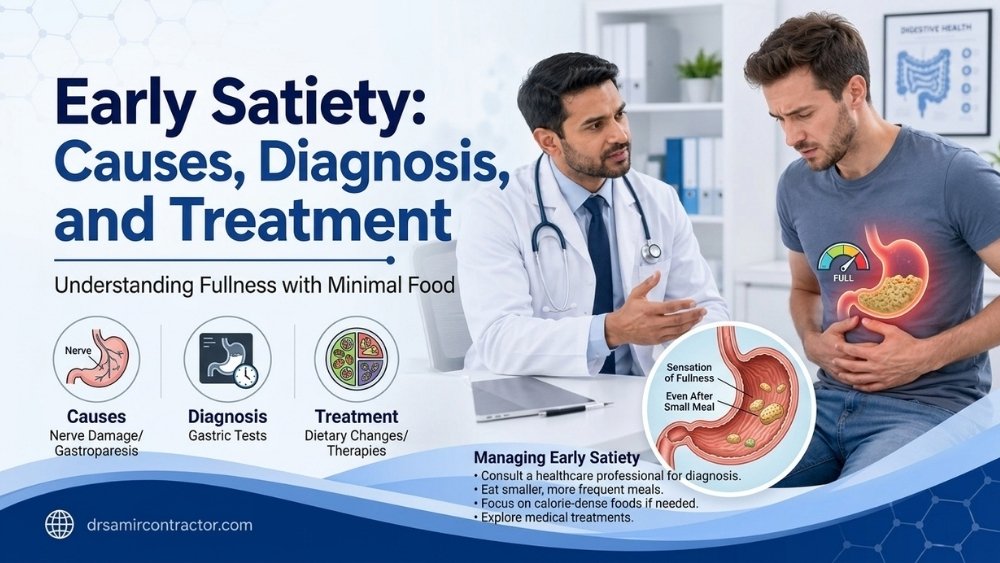
Early satiety is the sensation of feeling full after eating only a few bites - well before finishing a normal meal. It is more than post-meal heaviness. When progressive or associated with weight loss, it is a red-flag symptom that must be evaluated. Most causes are benign and treatable, but gastric cancer must be excluded in patients above 45.
✦ Quick Answers
Most people know what it is like to feel full after a large meal. Early satiety is different - it is feeling full after two or three bites of a meal you have barely started. Patients describe it as "my stomach has shrunk," "I can't eat like I used to," or "I feel stuffed before I have even had half my roti." Some manage by grazing on tiny amounts throughout the day; others simply stop eating properly.
When this symptom develops gradually over weeks and is accompanied by unintended weight loss, it moves firmly into red-flag territory. The symptom pattern - early satiety with progressive weight loss - is one of the classic presentations of gastric cancer. The vast majority of patients with early satiety do not have cancer, but the only way to be confident is to investigate. The good news is that endoscopy is quick, safe, and gives a definitive answer.
What Is Early Satiety?
Early satiety (pronounced sat-eye-uh-tee) means the feeling of fullness that arrives much sooner than it should during a meal - after only a small amount of food. It is a symptom, not a disease. It occurs when the stomach's ability to accommodate food is impaired, when the stomach empties too slowly, or when a physical obstruction prevents food from moving through normally.
It is important to separate early satiety from two related but different symptoms:
Normal Fullness
Feeling full at the end of a normal-sized meal. Expected and appropriate. Disappears within 1-2 hours. No impact on food intake or weight.
Postprandial Fullness
Uncomfortable fullness that lingers for hours after a meal. Food intake may be normal but discomfort follows. Common in functional dyspepsia. Needs evaluation if persistent.
Early Satiety
Full after just 2-3 bites. Cannot finish a meal. Recurring or progressive. Often leads to reduced food intake and weight loss. Always warrants medical evaluation.
How Early Satiety Presents
What patients typically describe
- Feeling full after eating only 2-4 bites - regardless of what the food is
- Inability to finish a meal that used to be easy to complete
- Stomach feeling "tight" or "closed off" within minutes of starting to eat
- Eating smaller and smaller amounts over successive weeks
- Nausea when trying to eat more than a small amount
- Skipping meals because eating is uncomfortable or unpleasant
- Unexplained weight loss over weeks or months - a direct consequence
Associated symptoms that guide the cause
- Nausea and vomiting of old food - strongly suggests gastroparesis
- Heartburn, reflux, regurgitation - GERD or gastritis as contributing factor
- Upper abdominal pain or discomfort - peptic ulcer, gastritis, or gastric cancer
- Progressive difficulty swallowing - raises concern for esophagogastric junction cancer
- Fatigue and pallor - anaemia from blood loss or malnutrition
- Back pain with early satiety - suggests pancreatic pathology
What Causes Early Satiety?
Common Benign Causes
- Functional dyspepsia - impaired gastric accommodation - the stomach normally relaxes (accommodates) as food enters, expanding to receive the meal. In functional dyspepsia, this accommodation reflex is impaired - the stomach cannot relax adequately, so even small amounts of food produce a fullness signal. The most common cause of early satiety
- Gastroparesis - delayed stomach emptying causes food to accumulate, leaving the stomach feeling full long before the next meal begins. Each subsequent meal finds a stomach that has not fully emptied. Common in long-standing diabetics
- H. pylori gastritis - active infection inflames the stomach lining and impairs gastric motility, reducing accommodation and producing early fullness
- GERD and erosive esophagitis - esophageal and gastric inflammation reduces the comfortable capacity of the stomach
- Post-vagotomy syndrome - after previous abdominal surgery involving the vagus nerve, gastric accommodation may be permanently impaired
- Medications - opiates, certain antidepressants, anticholinergics, and GLP-1 agonists (used for diabetes/obesity) all slow gastric emptying
- Post-bariatric surgery - expected rapid satiety after sleeve gastrectomy or bypass; part of the surgical mechanism. Abnormal in context means vomiting, pain, or inability to tolerate even liquid
Serious Causes to Exclude
- Gastric cancer - progressive early satiety with weight loss is one of the most characteristic early presentations. The tumour reduces the stomach's effective volume. Must be excluded by endoscopy in all patients with this symptom pattern above age 45
- Gastric outlet obstruction - from chronic peptic ulcer scarring or a tumour at the pylorus (stomach outlet). Causes early satiety, vomiting of old food, and weight loss
- Pancreatic cancer - can cause early satiety, upper abdominal fullness, and weight loss, often with back pain
- Large intra-abdominal mass - pressing on the stomach from outside and reducing its effective capacity
- Linitis plastica - a specific infiltrative type of gastric cancer where tumour grows throughout the stomach wall, making it stiff and unable to expand; causes very rapid, severe early satiety and weight loss
When Should You Worry? Red Flags
Seek urgent evaluation if early satiety is:
- Progressive - you can eat less and less over successive weeks
- Associated with unintended weight loss - even gradual
- New onset in a person above 45 years of age
- Associated with vomiting of old, partially digested food - hours after eating
- Associated with progressive difficulty swallowing
- Present alongside upper abdominal pain, especially with back pain
- Associated with anaemia (confirmed or suspected - fatigue, pallor, breathlessness)
- Present in someone with a family history of gastric cancer
- Associated with blood in vomit or black, tarry stool
Early satiety that has been stable for months, occurs in a young person, is clearly linked to stress or irregular eating, and is not causing weight loss is far less concerning than progressive early satiety developing over weeks in an older patient. Context determines urgency.
Who Is at Higher Risk?
- Long-standing diabetic patients - diabetic gastroparesis impairs gastric accommodation and emptying; early satiety is one of the most consistent presenting symptoms
- Patients above 45 with new-onset early satiety - gastric cancer risk increases significantly in this group; evaluation is mandatory
- People with H. pylori infection - active gastritis from H. pylori reduces gastric accommodation and produces early satiety alongside other dyspeptic symptoms
- Those with a family history of gastric cancer - first-degree relatives of gastric cancer patients have a higher lifetime risk; early satiety in this group warrants early endoscopy
- Regular NSAID users - gastric irritation and mucosal damage impair gastric function and can produce early satiety alongside nausea and abdominal pain
- Post-bariatric surgery patients - satiety changes are expected; excessive early satiety or vomiting suggests a surgical complication requiring evaluation
- Patients with chronic pancreatitis - reduced pancreatic enzyme output affects digestion and can produce early satiety from malabsorption and impaired gastric motility
- People on GLP-1 receptor agonists (semaglutide, liraglutide - used for diabetes and obesity) - these medications directly reduce gastric emptying rate and produce pharmacological early satiety as part of their mechanism of action
How Doctors Evaluate Early Satiety
Unlike symptoms where empirical treatment before investigation is appropriate, early satiety - particularly in patients above 45 or with associated weight loss - warrants investigation before treatment begins. The history is structured around urgency assessment:
- How soon after starting a meal does fullness develop?
- How many bites or how much food triggers the sensation?
- Is it getting worse over time - eating less each week?
- How much weight has been lost, and over what period?
- Is there vomiting - and what does it look like?
- Is there upper abdominal pain, back pain, or difficulty swallowing?
- Is there a history of diabetes - and how well is it controlled?
- What medications are currently being taken?
- Is there a family history of gastric cancer?
Physical examination focuses on the upper abdomen for a palpable mass or tenderness, nutritional status, anaemia signs, and the presence of any neck or supraclavicular lymph nodes (which may be enlarged from gastric cancer spread). The combination of history and examination determines whether endoscopy is urgent or can proceed on a routine basis.
Tests That May Be Needed
Upper GI Endoscopy (primary investigation)
The most important test for early satiety - particularly when red flags are present or the patient is above 45. Directly visualises the stomach lining, identifies gastritis, ulcers, mass lesions, and pyloric obstruction. Biopsies are taken from any suspicious area. A normal endoscopy is highly reassuring and supports a functional or gastroparesis diagnosis.
Gastric emptying scan
The definitive test for gastroparesis. The patient eats a standardised radiolabelled meal and imaging tracks how quickly the stomach empties over 4 hours. Performed when gastroparesis is suspected - particularly in diabetic patients with nausea, vomiting, and early satiety. If endoscopy is normal and gastroparesis is likely, this is the next step.
Blood tests
Full blood count (anaemia), blood glucose and HbA1c (diabetes assessment), liver function, nutritional markers (albumin, pre-albumin), and CA 19-9 or CEA tumour markers in selected cases when malignancy is suspected. Thyroid function (hypothyroidism can slow gastric motility).
Ultrasound abdomen
Identifies gallstones, liver lesions, and mass lesions pressing on the stomach from outside. Part of the initial workup when the cause of early satiety is not clear from history and endoscopy.
CT scan of abdomen
For staging when gastric cancer is confirmed, or when pancreatic pathology or a large intra-abdominal mass is suspected. Not a primary investigation for early satiety but essential when serious pathology is identified on endoscopy.
Treatment Options
Treatment is cause-specific. The approach differs significantly between functional dyspepsia, gastroparesis, H. pylori gastritis, and structural causes.
Cause-Specific Treatment Pathways
- 1️⃣ Functional Dyspepsia - Impaired Gastric Accommodation: Small, frequent meals (5-6 per day). Eat slowly. Avoid oily, fatty, and gas-forming food. PPI therapy reduces acid and may improve accommodation. Low-dose tricyclic antidepressants (amitriptyline, nortriptyline) at sub-therapeutic doses are effective for gastric hypersensitivity in functional dyspepsia - not for depression, but for their gut-sensitising effect. Prokinetic agents (domperidone, itopride) in selected patients.
- 2️⃣ Gastroparesis: Low-fat, low-fibre diet in 6-8 small meals daily. Liquid and semi-solid meals empty faster than solid food. Prokinetic agents (domperidone, metoclopramide) improve gastric motility. Strict glucose control in diabetic gastroparesis - hyperglycaemia itself slows gastric emptying further. In severe refractory cases - gastric electrical stimulation, endoscopic procedures, or jejunal feeding.
- 3️⃣ H. pylori Gastritis: 14-day eradication course (antibiotics + PPI). Eradication reliably improves early satiety and dyspeptic symptoms in H. pylori-positive patients. Confirm eradication with breath test 4-6 weeks after completing treatment. Most patients need no further medication after successful eradication.
- 4️⃣ GLP-1 Medication-Induced Satiety: If early satiety is from a GLP-1 receptor agonist (semaglutide, liraglutide), discuss with the prescribing physician whether dose adjustment is appropriate. This is often intentional weight-loss mechanism - distinguish from pathological early satiety. If causing inadequate nutrition, dose review is needed.
- ? Gastric Cancer / Structural Obstruction: Multidisciplinary team management - surgery, chemotherapy, radiotherapy. Gastric outlet obstruction may be managed endoscopically (balloon dilation) or surgically. Nutritional support - often requiring feeding tube - is essential when early satiety is preventing adequate oral intake pending definitive treatment.
Eating Strategy for Early Satiety - Indian Context
- Frequency over volume: 6-8 small meals or snacks per day instead of 2-3 large thalis. This is the single most effective dietary strategy - every time the stomach is small-filled rather than large-filled
- Best food choices: Liquid and semi-soft foods empty faster - smooth dal, thin chaas, soft khichdi, curd, banana, soft cooked batata, smooth soups with protein (dal ka pani, chicken broth)
- Calorie density: When the volume you can eat is very small - each mouthful must count nutritionally. Fortified liquids, protein-rich soft foods (eggs, paneer in soft form, dal) are better than dilute or carbohydrate-only choices
- Avoid gas-forming food: These add to abdominal distension and worsen the fullness signal - rajma, chole, cabbage, and carbonated drinks
- Lying flat after eating worsens gastroparesis: Remain seated or walk briefly after eating. Gravity assists gastric emptying
- If weight loss is occurring: See a doctor - dietary modification alone is not sufficient when early satiety is causing progressive weight loss
When Is Surgery Needed?
- Gastric cancer - gastrectomy (partial or total) with curative intent in operable early-stage disease; palliative bypass or stenting for advanced disease causing obstruction
- Gastric outlet obstruction from peptic ulcer scarring - surgical correction (pyloroplasty or gastrojejunostomy) when endoscopic balloon dilation fails to provide adequate relief
- Severe refractory gastroparesis - in highly selected patients, gastric electrical stimulation (GES device implantation) or surgical bypass procedures. These are specialist-centre decisions
- Large extrinsic mass compressing the stomach - surgical or interventional management depending on the cause and nature of the mass
What Happens If Early Satiety Is Ignored?
- Progressive malnutrition - inadequate food intake from early satiety leads to protein-energy malnutrition, muscle wasting, vitamin deficiencies, and progressive weakness
- Significant weight loss - patients lose kilograms over weeks, which compounds weakness and immune function impairment
- Missed gastric cancer diagnosis - early satiety with weight loss is an early sign of gastric cancer. Patients who ignore this and present months later have often progressed from operable to inoperable disease. The outcome difference between stage I and stage IV gastric cancer is profound
- Worsening gastroparesis - uncontrolled diabetes accelerating vagal nerve damage; erratic glucose due to unpredictable food absorption creating a vicious cycle
- Hospitalisation for dehydration and malnutrition - severe early satiety that prevents oral intake eventually requires inpatient nutritional support
Progressive early satiety with weight loss is one of the most important symptom patterns not to ignore. The window between a diagnosis at an operable stage and an inoperable stage for gastric cancer can be a matter of months.
Recovery and What Patients Can Expect
wk
wk
term
Op
Frequently Asked Questions
Early Satiety in India - What Is Relevant for You
Why early satiety is clinically important in the Indian context
- India has one of the world's highest H. pylori infection burdens - active gastritis from this infection is a common, treatable cause of early satiety that goes untested in most patients who receive only antacid treatment
- India has the world's largest diabetic population - diabetic gastroparesis is an under-diagnosed cause of progressive early satiety and nausea in long-standing diabetics. Poor HbA1c control accelerates the condition
- Gastric cancer is among India's more common GI cancers. Early satiety with weight loss is one of its most consistent early presentations. The symptom is frequently misattributed to acidity or stress for months - often until the disease has advanced
- Semaglutide (Ozempic) and other GLP-1 agonists are increasingly prescribed for obesity and diabetes in India - pharmacological early satiety from these agents needs to be distinguished from pathological early satiety in patients taking them
- Post-bariatric early satiety is expected after surgery at centres like Sterling Hospital Vadodara - but abnormal satiety with vomiting or pain needs to be flagged early to the surgical team
When and Where to Seek Care in Vadodara
If you are feeling full after just a few bites - particularly if this has been worsening over weeks, or if you have lost weight - consult Dr Samir Contractor at Sterling Hospital, Vadodara. Upper GI endoscopy, gastric emptying scan, and H. pylori testing are all available to identify the underlying cause precisely.
Early satiety with weight loss in a patient above 45 is one of the most time-sensitive symptom combinations in GI medicine. Getting an endoscopy done promptly can make the difference between a treatable diagnosis and an advanced one.
Desi Patient Questions (Gujarati / Hinglish)
Ha - bilkul. Thodi vastu khata j full feel karvanu - early satiety - evaluate karvu joiye. Jyaré weight pan ghatu thatu hoy to urgently javo. Endoscopy quickly answer aapé chhe - functional cause hoy to treatment available chhe, ane jyaré koi serious cause hoy to early detection kaam aavé chhe.
Ha - diabetic gastroparesis possible chhe. Long-standing diabetes vagus nerve ne damage kare chhe je stomach emptying slow kare chhe. Gastric emptying scan thi confirm thay. Nana frequent meals, prokinetic medicine, ane tight glucose control - aa trane important treatment components chhe. Doctor ne malsho ane HbA1c check karo.
"Stomach shrunk" feeling actually impaired gastric accommodation chhe - functional dyspepsia common cause chhe. Stomach physically nahi sichratu - but its flexibility to relax as food enters is reduced. Nana meals, oily food ochha karo, ane doctor prescribed medication typically help. Jyaré weight loss pan hoy to endoscopy pehla karo.
Ha - immediate endoscopy zaruri chhe. Above 45 + early satiety + weight loss = urgent evaluation combination. Majority cases ma benign cause milshe - pun gastric cancer exclude karvu mandatory chhe. Early detection outcome dramatically change kare chhe. Please delay na karo.
Semaglutide intentionally early satiety produce kare chhe - ee medication ni mechanism chhe. Jyaré weight loss plan ma hoy to aa expected chhe. Pan jyaré nutrition adequate nathi - protein, vitamins insufficient chhe - to prescribing doctor sathe dose discuss karo. Medication-induced vs. pathological early satiety distinguish karvanu important chhe.