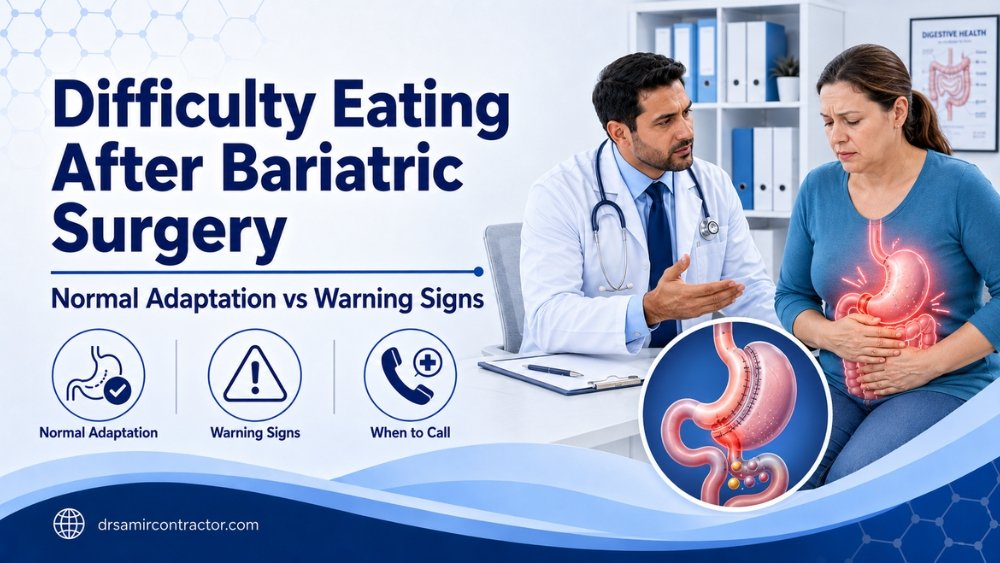
Eating difficulties after bariatric surgery are extremely common and, in most cases, a sign that your body is adjusting to a smaller stomach. Knowing what is expected at each stage - and recognising when something needs medical attention - helps patients recover with confidence and avoid unnecessary worry.
✦ Quick Answers
If you are reading this page, you have likely had bariatric surgery - a sleeve gastrectomy, gastric bypass, or another weight loss procedure - and you are finding it difficult to eat the way you used to. That is understandable, and in most cases, it is exactly what is supposed to happen.
Bariatric surgery works by reducing stomach size and, in some procedures, changing the path food takes through your digestive system. This means your body needs time to learn how to eat differently. Most patients go through a period of adjustment that involves smaller meals, slower eating, and temporary difficulty with certain foods.
The challenge is knowing the difference between expected adaptation and a problem that needs medical attention. This page will walk you through what is normal at each stage, which foods tend to cause trouble (with specific guidance for Indian diets), when to be concerned, and what your surgeon can do to help.
What Is Normal Eating Adaptation After Bariatric Surgery?
After sleeve gastrectomy, the stomach is reduced to roughly 20% of its original size. After gastric bypass, both the stomach pouch and the digestive pathway are altered. In both cases, you should expect significant changes in how you eat.
Expected changes that are not a cause for concern
- Much smaller portions - you may only be able to eat 2 to 4 tablespoons per meal in the early weeks, gradually increasing to about half a cup by 3 months
- Early fullness - feeling full after just a few bites is one of the mechanisms through which bariatric surgery works
- Slower eating required - meals may take 20 to 30 minutes for what would previously have been a 5-minute snack
- Temporary food intolerances - red meat, bread, sticky rice, and raw vegetables commonly cause discomfort initially
- Changed taste preferences - many patients find that previously enjoyed foods taste different or are less appealing
- Mild nausea if eating too fast - a signal to slow down, not a sign of a complication
Reassurance: These Are Signs of Successful Adaptation
- Feeling satisfied with small meals and not hungry between them
- Gradually tolerating a wider variety of foods each month
- Steady, predictable weight loss in line with your surgical team's guidance
- Learning to chew thoroughly and eat slowly without discomfort
- Occasional intolerance to a food that improves when tried again later
Food Tolerance Timeline: What to Expect and When
Every patient is different, but the following timeline reflects what most bariatric patients experience. Use this as a general guide - your surgeon's specific instructions always take priority.
| Time After Surgery | What You Can Usually Eat | Common Difficulties | What's Normal |
|---|---|---|---|
| Week 1-2 | Clear liquids, thin dal water, coconut water, buttermilk, diluted juices | Cannot tolerate anything thick or with pulp; even sipping too fast causes discomfort | Sipping 30-60 ml at a time; mild nausea; low appetite |
| Week 2-4 | Full liquids and pureed foods: thin khichdi, curd, blended soups, protein shakes | Lumpy textures cause discomfort; spices not well tolerated; satiety after 3-4 spoons | Eating 60-90 ml per meal; taste changes; some food aversions |
| Month 1-2 | Soft foods: soft paneer, scrambled egg, dalia, soft cooked vegetables, flaked fish | Red meat, bread, roti, dry chicken cause sticking or heaviness; eating too fast causes nausea | Tolerating 100-150 ml per meal; 5-6 small meals a day |
| Month 3-4 | Most soft-cooked foods; well-chewed roti in small pieces; minced chicken; dal-rice in small quantities | Dry or fibrous foods still difficult; need 20+ minutes per meal; occasional intolerance | Half cup per meal; reducing to 4-5 meals a day; most vegetables tolerated |
| Month 6+ | Most regular foods in smaller portions with thorough chewing | Some patients retain lifelong difficulty with very dry meat, large bread pieces, or sticky rice | Three-quarter cup per meal; 3 meals + 1-2 snacks; stable food tolerance |
Note: This timeline is approximate. Sleeve gastrectomy and gastric bypass patients may differ. Always follow your surgical team's specific dietary protocol.
When Eating Difficulty Is Not Normal: Warning Signs
While most eating difficulties after bariatric surgery are part of the expected adjustment, certain patterns suggest a problem that needs evaluation. Do not assume all discomfort will resolve on its own.
Seek Evaluation From Your Bariatric Surgeon If You Have:
- Complete inability to tolerate any solid food beyond 6 to 8 weeks after surgery
- Food consistently getting stuck - especially at the same point every time (suggests stricture or stenosis)
- Vomiting after every meal or most meals, regardless of what you eat or how slowly you eat
- Progressive inability to tolerate foods you were previously managing
- Significant fear or anxiety about eating leading to avoidance of meals
- Rapid, excessive weight loss beyond what your surgeon expects
- Signs of nutritional deficiency: extreme fatigue, hair loss, tingling in hands and feet, muscle cramps
- Inability to meet daily protein or fluid intake targets despite best efforts
- Persistent acid reflux or burning that worsens with eating
What could be causing persistent difficulty?
Usually Correctable
- Eating too fast or not chewing enough
- Taking bites that are too large
- Drinking fluids during meals (fills the small pouch)
- Eating foods that are too dry or fibrous
- Not following the staged dietary plan
- Psychological food aversion or anxiety
May Need Medical Intervention
- Stricture (narrowing at the surgical connection)
- Stenosis at the sleeve or anastomosis
- Staple line issues or marginal ulcer
- Severe gastroesophageal reflux
- Internal hernia (gastric bypass)
- Maladaptive eating disorder requiring counselling
Stricture and Stenosis: When Food Physically Cannot Pass
A stricture is a narrowing that develops at or near the surgical site. After gastric bypass, it most commonly occurs at the gastrojejunal anastomosis (the connection between the stomach pouch and the intestine). After sleeve gastrectomy, narrowing can occur along the staple line, particularly at the incisura (the natural bend in the stomach).
How stricture presents
- Food getting stuck at the same point repeatedly
- Progressive difficulty - tolerating soft foods at first, then struggling with those too
- Vomiting soon after eating, often before food reaches the intestine
- Inability to advance through the dietary stages as expected
How it is diagnosed and treated
An upper GI endoscopy is the primary investigation. If a stricture is confirmed, endoscopic balloon dilation is usually effective. This is a non-surgical procedure performed under sedation, where a balloon is gently inflated at the narrowed site to widen it. Most patients need one to three dilation sessions. Surgery is rarely required.
Stricture rates are approximately 3 to 5% after gastric bypass and 1 to 2% after sleeve gastrectomy. It is not a failure of surgery - it is a known, treatable complication.
The Psychological Side: Food Fear and Maladaptive Eating
Not all difficulty eating after bariatric surgery has a physical cause. The relationship between a person and food changes dramatically after weight loss surgery, and this adjustment is as much psychological as it is physical.
Common psychological eating patterns after bariatric surgery
- Fear of eating - after one or two episodes of vomiting or food getting stuck, some patients become anxious about eating altogether and start avoiding meals
- Restrictive eating - eating only a very limited set of "safe" foods, leading to nutritional gaps
- Grazing - instead of structured meals, patients nibble small amounts throughout the day, which can reduce weight loss effectiveness
- Food mourning - genuine grief over the loss of favourite foods and the social role of eating
- Transfer of coping mechanisms - patients who used food for emotional comfort may shift to other behaviours when food is no longer available in the same way
These patterns are common and do not indicate weakness. They are a recognised part of post-bariatric adjustment. If eating difficulty is driven by anxiety, fear, or disordered patterns rather than physical symptoms, discuss this with your bariatric team. Nutritional counselling and, in some cases, psychological support can make a significant difference.
Struggling With Eating After Bariatric Surgery?
Whether it is expected adaptation or something that needs attention, Dr Samir Contractor can help you identify the cause and get back on track. Comprehensive post-bariatric evaluation at Sterling Hospital, Vadodara.
Foods That Commonly Cause Trouble After Bariatric Surgery
Certain food categories are reported as difficult by a large proportion of bariatric patients. Knowing these in advance helps you plan meals and set realistic expectations.
| Food Category | Why It Causes Trouble | Practical Tip |
|---|---|---|
| Red meat (mutton, beef) | Dense, fibrous texture is hard to break down in a small stomach | Try keema (minced) first; reintroduce very small, well-cooked pieces after month 3 |
| Bread / roti / naan | Doughy texture forms a ball that can block the outlet | Start with dalia or thin soft roti; take tiny pieces chewed thoroughly |
| Rice | Sticky, expands after swallowing, fills the pouch quickly | Begin with khichdi; progress to curd rice in very small amounts |
| Raw vegetables / salad | Fibrous, hard to break down, may cause bloating | Steam or cook vegetables well; introduce raw options gradually after month 4 |
| Dry chicken or fish | Lack of moisture makes it difficult to swallow and pass through | Cook in curry or gravy; flake rather than eat in chunks |
| Carbonated drinks | Gas distends the small pouch, causing pain and bloating | Avoid entirely; switch to plain water, coconut water, or buttermilk |
| Very spicy food | Irritates the new stomach lining, especially in early months | Reintroduce mild spices after month 2; build up gradually |
How Your Surgeon Evaluates Persistent Eating Difficulty
When eating problems persist beyond the expected timeline or worsen instead of improving, your bariatric surgeon will take a structured approach to identify the cause.
Evaluation Steps
- Detailed Dietary History: Review of what you are eating, how much, how fast, and at what dietary stage you are. Many problems are correctable with adjustments to eating technique and food choices.
- Symptom Pattern Analysis: Is the difficulty with all foods or specific ones? Does food get stuck at a consistent point? Is there associated reflux, nausea, or vomiting? Pattern helps distinguish behavioural from structural causes.
- Upper GI Endoscopy: The most informative investigation. Directly visualises the stomach, surgical site, and any narrowing, ulceration, or structural issue. Can often treat the problem (dilation) during the same procedure.
- Barium Swallow or Upper GI Series: An X-ray study with contrast that shows the shape and emptying of the stomach. Useful for assessing the overall anatomy and detecting leaks or obstruction.
- Nutritional and Psychological Assessment: Blood tests for protein, vitamins, and minerals. Evaluation for maladaptive eating patterns, food anxiety, or disordered eating that requires specific support.
Practical Tips to Improve Eating After Bariatric Surgery
Most eating difficulties improve significantly when patients adopt a structured, mindful approach to meals. These are the strategies that make the biggest difference in clinical practice.
- Chew every bite 20 to 30 times - food should be the consistency of a paste before you swallow. This single habit prevents most episodes of food getting stuck.
- Take 20 to 30 minutes per meal - set a timer if needed. Rushing is the most common cause of post-meal nausea and vomiting.
- Separate food and drinks - do not drink 30 minutes before, during, or 30 minutes after a meal. Liquids fill the small pouch and push food through too fast or cause discomfort.
- Eat protein first - start each meal with your protein source (egg, paneer, dal, fish, chicken), then vegetables, then carbohydrate if there is room.
- Stop at the first sign of fullness - the feeling of fullness after bariatric surgery is different from before. A slight pressure or tightness means stop. Do not push through it.
- Introduce one new food at a time - if it causes a problem, you know exactly which food is responsible. Try it again in a week or two.
- Keep a food diary - tracking what you eat and how it affects you helps identify patterns and gives your surgical team useful information.
- Do not skip meals - skipping leads to overeating at the next meal, which causes discomfort and vomiting. Small, regular meals are better than fewer large ones.
Indian Food Adaptation Guide After Bariatric Surgery
Indian diets are centred around roti, rice, dal, and sabzi - foods that require specific adaptation after bariatric surgery. The good news is that Indian cuisine is highly flexible, and most patients resume eating familiar foods with modifications.
Roti and Bread Alternatives
- Weeks 2-4: Dalia (broken wheat porridge) - soft, easy to digest, good source of carbohydrate
- Month 1-2: Very thin, soft phulka torn into tiny pieces; moong dal cheela; besan cheela
- Month 3+: Small soft roti in tiny pieces, chewed thoroughly. Avoid thick, dry roti or paratha initially.
- Tip: Dip roti in dal or curry to soften it. Never eat dry roti after bariatric surgery.
Rice and Grain Alternatives
- Weeks 2-4: Thin moong dal khichdi (well-mashed, watery consistency)
- Month 1-2: Curd rice in very small amounts; dalia upma; soft poha (flattened rice)
- Month 3+: Small portions of plain rice with dal or rasam. Avoid biryani, pulao, or dry fried rice in the first 6 months.
- Tip: Cook rice softer than usual. Mix with dal or curd to prevent it from forming a sticky ball.
Dal and Protein Progression
- Week 1-2: Strained dal water (clear, no pulp)
- Week 2-4: Thin moong dal, masoor dal - well-cooked and slightly blended
- Month 1-2: Regular dal consistency; soft paneer; scrambled egg; protein powder in milk or curd
- Month 3+: Chana dal, rajma (well-cooked); chicken in gravy; flaked fish
- Tip: Protein is the most important macronutrient after bariatric surgery. Aim for 60-80 grams daily. If you cannot meet this through food alone, use a protein supplement as directed by your dietitian.
Vegetables and Fruits
- Month 1-2: Well-cooked, mashed vegetables - lauki, tori, bhindi (okra), pumpkin, carrots
- Month 3+: Steamed or sauteed sabzi; gradually introduce raw cucumber and tomato
- Fruits: Start with banana, papaya, and chiku (sapodilla). Avoid citrus on an empty stomach initially.
- Tip: Peel tough skins. Cut into very small pieces. Avoid fibrous vegetables like raw cabbage and radish until month 4 or later.
Meals Indian Patients Tolerate Well in Early Recovery
- Moong dal khichdi with a small amount of ghee
- Curd rice (dahi bhaat) - mashed and in small portions
- Paneer bhurji (crumbled, with minimal oil)
- Egg bhurji (scrambled eggs with soft vegetables)
- Thin vegetable soup or rasam
- Protein shake blended with banana or curd
- Buttermilk (chaas) between meals - excellent for hydration
Frequently Asked Questions
Desi Patient Questions (Gujarati / Hinglish)
Ha, surgery pachhi pahela 2-3 mahina appetite ghani ochi hoy chhe. Aa ghrelin hormone ochi thavathi thay chhe. Pan tamaru protein ane nutrition target follow karvu jaruri chhe - bhukh na lage toye niyamit khavo.
Roti nanu nanu tokda karyo ane 20-30 vakhat chavjo. Sukhi roti avoid karo - dal ma ya curry ma bolvine khao. Agar varamvar aatkti hoy to doctor ne batavo, stenosis check karvu pade.
Ha, pan gradually. Pahela khichdi thi start karo, pachhi dahi bhaat thodu thodu try karo. 3 mahina pachhi plain bhaat nani quantity ma chale. Biryani ane pulao 6 mahina sudhi avoid karo.
Har meal pachhi ulti thay toh aa normal nathi. Stricture ya bija problem hoi shake. Doctor pase jaav - endoscopy thi check thay chhe ane majority cases ma simple treatment thi thik thay chhe.
Surgery pachhi stomach nanu thai gayu chhe - ek nana kela jetlu. Vadhare khavathi takleef thay. Doctor ni guidelines family ne batavo. Follow-up ma family ne saath laavo - doctor bhi samjhavi dese.
Paneer bhurji, egg whites, dal, soya chunks - aa badha saara protein sources chhe. Protein powder curd ma ya banana sathe blend kari ne try karo. Dietitian pase jao - tamara taste mujab alternative suggest karse.