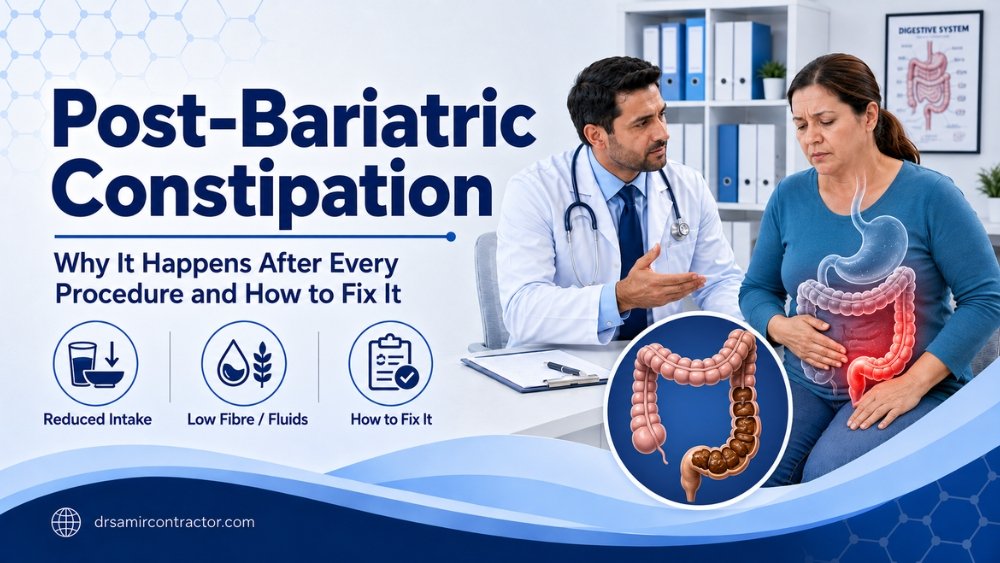
Constipation is the single most reported GI complaint after bariatric surgery, affecting 30-50% of patients regardless of procedure type. The causes are procedure-specific - ranging from drastically reduced food bulk and mandatory iron supplements to altered gut anatomy and post-operative inactivity. This page is a disease-level guide covering the mechanisms behind post-bariatric constipation for each procedure (sleeve gastrectomy, Roux-en-Y gastric bypass, OAGB), a practical fibre progression protocol using Indian foods, safe laxative options, hydration targets, and the red flags that demand urgent surgical evaluation.
✦ Quick Answers
Post-Bariatric Constipation - A Distinct Clinical Problem
Constipation after bariatric surgery is not the same as constipation during general weight loss from dieting or GLP-1 medications. While the symptom may appear identical - infrequent stools, straining, hard pellet-like stool, bloating - the underlying mechanisms are specific to the altered anatomy and the medical demands of post-surgical recovery. A patient who has undergone sleeve gastrectomy faces different constipation drivers than someone who has had a Roux-en-Y gastric bypass. The management protocol must account for these differences.
This page is the disease-level companion to our constipation after rapid weight loss symptom guide. If you are experiencing constipation from dieting, keto, or GLP-1 medications (semaglutide, tirzepatide) without having had surgery, that page may be more relevant to you. This page focuses specifically on post-surgical constipation - its procedure-specific causes, the practical fibre progression plan for each surgical stage, safe medications, and the critical moments when constipation signals a surgical complication.
Understanding these distinctions matters. The difference between a patient who needs more isabgol and water versus a patient with an evolving internal hernia after gastric bypass is the difference between a routine dietary adjustment and a surgical emergency.
Why Each Bariatric Procedure Causes Constipation Differently
All bariatric procedures reduce food intake, which reduces stool bulk. But the specific mechanisms that cause constipation differ by procedure. Knowing which factors are at play after your surgery helps you target the right solutions.
Sleeve Gastrectomy
- Stomach reduced to 20-25% of original size
- Food intake drops to 300-500 ml/meal
- Intestinal tract completely unchanged - normal length colon absorbs more water from reduced stool volume
- Iron + calcium supplements started (both constipating)
- High-protein diet emphasis reduces fibre intake
- Constipation rate: 40-50%
Roux-en-Y Bypass
- Tiny stomach pouch (30-50 ml) + intestinal rerouting
- Bypassed duodenum = poor iron absorption = higher iron doses needed
- Altered bile salt circulation may affect colonic motility
- Risk of anastomotic stricture causing mechanical obstruction
- Internal hernia risk at mesenteric defects
- Constipation rate: 35-45%
OAGB / Mini Bypass
- Long gastric pouch + single intestinal connection
- Longer biliopancreatic limb = greater malabsorption
- Bile reflux can cause nausea, reducing oral intake further
- Higher supplement burden (iron, calcium, B12, fat-soluble vitamins)
- Combined restrictive + malabsorptive constipation drivers
- Constipation rate: 30-40%
The seven converging factors
Regardless of procedure type, post-bariatric constipation results from multiple factors operating simultaneously. Understanding each one helps you address them systematically rather than relying on a single fix.
- Drastically reduced food volume: After any bariatric procedure, total food intake drops by 60-80%. Less food entering the colon means less residue to form stool. Without adequate bulk, the colon cannot generate the coordinated mass-movement contractions needed to propel stool forward. This is the single largest contributor.
- Inadequate fluid intake: The reduced stomach capacity makes it physically difficult to drink enough. Patients cannot gulp large volumes - they must sip 60-90 ml every 15-20 minutes. Many patients fall short of the 2-2.5L daily target, and the colon compensates by extracting more water from stool, producing dry, hard stool.
- Iron and calcium supplements: Post-bariatric protocols mandate iron (especially after bypass procedures where the duodenum is bypassed) and calcium supplementation. Ferrous sulfate in particular produces hard, dark stools and slows colonic transit. Calcium carbonate has a similar constipating effect. Patients taking both face a compounding burden.
- High-protein, low-fibre dietary pattern: Post-bariatric diets prioritise protein (60-80 g/day) to preserve muscle mass. Protein-rich foods - chicken, eggs, paneer, whey protein - contain virtually no fibre. Meanwhile, traditional high-fibre Indian foods (whole wheat roti, dal, sabzis, rice) are often restricted in the early months.
- Post-operative opioid use: Pain medications used in the first 1-2 weeks (tramadol, codeine-based preparations) are potent constipating agents. They directly slow colonic motility and reduce the urge to defecate.
- Reduced physical activity during recovery: Patients are advised to avoid strenuous activity for 4-6 weeks. Fatigue from caloric restriction further reduces movement. Physical activity directly stimulates colonic motility through the gastrocolic reflex - without it, transit slows.
- Altered gut microbiome: Bariatric surgery significantly changes the composition of gut bacteria. The post-surgical microbiome shift - combined with antibiotics given during surgery - may reduce microbial fermentation that normally produces short-chain fatty acids, which stimulate colonic water secretion and motility.
Constipation Profile: Procedure Comparison
This table summarises how constipation presents and resolves differently depending on which bariatric procedure was performed.
| Feature | Sleeve Gastrectomy | Roux-en-Y Bypass | OAGB / Mini Bypass |
|---|---|---|---|
| Constipation rate | 40-50% | 35-45% | 30-40% |
| Peak severity | Weeks 2-6 | Weeks 2-8 | Weeks 2-6 |
| Primary driver | Reduced intake + unchanged colon | Reduced intake + high-dose iron + stricture risk | Reduced intake + malabsorption + bile reflux reducing oral intake |
| Typical resolution | Month 2-3 with dietary progression | Month 2-4 (longer if stricture present) | Month 2-3 |
| Unique risk | Staple line kink causing functional obstruction (rare) | Internal hernia at mesenteric defects; anastomotic stricture | Afferent limb syndrome (rare) |
| Investigation trigger | No improvement by month 3 despite adequate management | Sudden onset severe pain + obstipation = CT urgently | Progressive worsening with bile vomiting |
Fibre Progression Protocol: Stage-by-Stage Indian Dietary Plan
Fibre cannot be introduced all at once after bariatric surgery. The restricted stomach needs time to heal and adapt. This graduated protocol matches fibre introduction to the standard post-bariatric dietary stages, using commonly available Indian foods.
Stage 1: Liquid Phase (Week 1-2)
- No solid fibre - stomach is healing
- Clear fluids: water, coconut water, thin dal ka paani, buttermilk (chaas)
- Sip 60-90 ml every 15-20 minutes
- Warm water with lemon in morning (gastrocolic reflex)
- No bowel movement for 3-5 days is expected
- Lactulose 15 ml at bedtime if no stool by day 4
Stage 2: Puree/Soft Phase (Week 3-6)
- Introduce isabgol: 1 tsp in 250 ml warm water at bedtime
- Soft papaya (2-3 tablespoons) at breakfast
- Thin dalia porridge (30 g dry, cooked smooth)
- Strained moong dal (provides gentle fibre + protein)
- Mashed banana (half) between meals
- Target 1.5-2L fluid daily
Stage 3: Soft Solids (Week 7-12)
- Isabgol increase to 1-2 tsp daily
- Papaya (1 cup / 150 g) at breakfast
- 1 medium guava with seeds (afternoon snack)
- Well-cooked palak, lauki, bhindi, turai
- Ground flaxseed (alsi) 1 tbsp in curd
- Moong dal khichdi with soft vegetables
- Target 2-2.5L fluid daily
Stage 4: Regular Diet (Month 4+)
- Isabgol 1-2 tsp as maintenance (long-term safe)
- Full fibre foods: whole wheat small roti, mixed dal, sabzi with fibre
- Methi (fenugreek) leaves - excellent fibre + iron
- Sprouted moong - high fibre, protein-rich
- Raw salad introduced gradually
- Aim for 20-25 g fibre/day (realistic post-bariatric target)
Sample Day - Constipation-Friendly Post-Bariatric Meal Plan (Month 2-3)
- Wake up: 1 glass warm water with lemon (stimulates gastrocolic reflex)
- Breakfast (30 min later): 3 tbsp soft papaya + 2 tbsp dalia porridge + 1 small glass chaas
- Mid-morning: Half a guava (with seeds) or 3 soaked prunes
- Lunch: 3-4 tbsp moong dal khichdi + 2 tbsp well-cooked palak/lauki
- Afternoon: 200 ml buttermilk (chaas) - fluid + probiotics
- Evening snack: 2 tbsp curd with 1 tsp ground flaxseed
- Dinner: 3 tbsp soft paneer bhurji + 2 tbsp mashed vegetables
- Bedtime: 1-2 tsp isabgol in 250 ml warm water
- Throughout day: Sip water to reach 2-2.5L total (carry a marked bottle)
- After dinner: 20-minute gentle walk
Key Principles for Post-Bariatric Bowel Regularity
- Isabgol is the single most effective and calorie-free fibre supplement - always take with at least 250 ml water
- Never introduce high fibre suddenly - increase gradually over weeks to avoid bloating and discomfort
- Hydration is non-negotiable: sip throughout the day rather than drinking large volumes at once
- Do not skip meals - even small, frequent meals keep the gut stimulated
- Morning warm water + breakfast within 30 minutes of waking maximises the gastrocolic reflex
- Walking 20-30 minutes daily is as effective as any laxative for mild constipation
- If iron supplements are the primary cause, ask your surgeon about ferrous bisglycinate instead of ferrous sulfate
Safe Laxatives After Bariatric Surgery
When dietary measures alone are not enough, pharmacological options can help. However, not all laxatives are equally appropriate after bariatric surgery. The altered anatomy must be considered.
| Agent | Type | Post-Bariatric Safety | Practical Notes |
|---|---|---|---|
| Isabgol (psyllium husk) | Bulk-forming | First line. Safe long-term after week 4. | Must take with 250+ ml water. Without adequate fluid, can worsen obstruction in a small pouch. |
| Lactulose | Osmotic | Safe from day 3-4 post-op. Well-tolerated. | 15-30 ml at bedtime. May cause bloating initially. Calorie content minimal. |
| PEG (polyethylene glycol) | Osmotic | Safe and effective. No significant calorie load. | 17 g in 250 ml water daily. Tasteless. Good alternative if lactulose causes excessive gas. |
| Bisacodyl (Dulcolax) | Stimulant | Short-term rescue only (1-2 days max). | Not for regular use. Can cause cramping. Use only when osmotic agents fail for acute episodes. |
| Liquid paraffin | Lubricant | Use with caution after bypass. | Safe after sleeve in small doses. Avoid long-term - interferes with fat-soluble vitamin absorption. |
| Prucalopride | Prokinetic | Specialist use for refractory cases. | Prescribed when bulk-forming + osmotic agents fail despite 4+ weeks of use. Requires medical supervision. |
| Glycerin suppositories | Rectal osmotic | Safe for acute relief. | Useful when oral agents are not working fast enough. Can be used as needed without dependency. |
Important: Avoid herbal or Ayurvedic laxatives containing senna or cascara in the early post-operative months - these stimulant agents can cause severe cramping in a healing surgical site. Churan and triphala, while culturally popular, should only be reintroduced after month 3 and only with your surgeon's approval.
Red Flags: When Post-Bariatric Constipation Signals a Complication
The majority of post-bariatric constipation is functional and responds to dietary and pharmacological management. However, certain patterns indicate a surgical complication that requires urgent evaluation. Missing these can be dangerous.
Seek Urgent Surgical Evaluation If:
- Complete inability to pass stool AND gas for 48+ hours - may indicate small bowel obstruction from internal hernia (especially after gastric bypass) or adhesive obstruction
- Severe, colicky abdominal pain with vomiting and constipation - classic triad of bowel obstruction; needs urgent CT abdomen
- Sudden onset severe abdominal pain after gastric bypass - internal hernia at Petersen's defect or jejunojejunal mesenteric defect until proven otherwise; surgical emergency
- Progressive worsening despite 4+ weeks of adequate fibre, fluids, and laxatives - suggests mechanical cause (stricture, kink, adhesion) rather than functional constipation
- Constipation + progressive difficulty swallowing + vomiting (post-bypass) - anastomotic stricture at gastrojejunal connection; needs upper GI endoscopy
- Blood in stool or black/tarry stools - marginal ulcer at anastomosis (bypass), staple line bleed (sleeve), or anal fissure from chronic straining
- Fever + abdominal pain + constipation in the first 30 days post-surgery - possible staple line leak or intra-abdominal collection
- New-onset right upper abdomen pain with constipation - gallstones (form rapidly after bariatric surgery; up to 30% within 6 months of rapid weight loss)
Internal hernia after gastric bypass - the critical diagnosis
After Roux-en-Y gastric bypass and OAGB, mesenteric defects created during surgery can allow loops of small bowel to herniate through. This internal hernia can cause intermittent or acute small bowel obstruction. The presentation is often dramatic: sudden severe abdominal pain, inability to pass stool or gas, vomiting, and a CT scan showing closed-loop obstruction with swirled mesenteric vessels (the "whirl sign"). This is a surgical emergency requiring laparoscopic exploration and reduction. Any post-bypass patient with sudden severe pain and absolute constipation must be evaluated urgently - delays can lead to bowel ischaemia and necrosis.
Anastomotic stricture - a treatable cause of worsening symptoms
The gastrojejunal anastomosis after Roux-en-Y bypass can narrow due to scarring, typically presenting 4-12 weeks post-surgery. The narrowing prevents food from passing, causing progressive difficulty eating, vomiting after meals, and - because almost no food reaches the colon - severe constipation. This is diagnosed by upper GI endoscopy and treated with endoscopic balloon dilatation, a non-surgical procedure performed under sedation. Most patients need one to three sessions. The stricture rate is approximately 3-5% after gastric bypass.
Gallstones after bariatric surgery
Rapid weight loss causes the liver to secrete cholesterol-saturated bile, which forms gallstones. Up to 30% of bariatric patients develop gallstones within the first 6 months. While gallstones do not directly cause constipation, both conditions occur simultaneously after bariatric surgery, and right upper abdomen pain combined with bowel changes should prompt an abdominal ultrasound. Symptomatic gallstones require laparoscopic cholecystectomy.
When to Investigate - and What Tests Are Needed
If post-bariatric constipation persists beyond 3 months despite adherence to fibre progression, adequate hydration (2-2.5L/day), and appropriate laxative use, investigation is warranted. Earlier investigation is needed if red-flag symptoms are present.
| Investigation | When to Order | What It Shows |
|---|---|---|
| Blood tests (TSH, calcium, glucose, FBC) | All patients with persistent constipation beyond 8 weeks | Hypothyroidism, hypercalcaemia, diabetes (all affect gut motility), anaemia from occult bleeding |
| Abdominal X-ray | Acute presentation with distension or suspected obstruction | Faecal loading, bowel dilatation, air-fluid levels (obstruction) |
| Abdominal ultrasound | Right upper abdomen pain, or routine screening at 6 months post-bariatric | Gallstones - extremely common after rapid weight loss |
| CT abdomen | Suspected obstruction, internal hernia, or acute abdomen - especially post-bypass | Internal hernia (whirl sign), closed-loop obstruction, intra-abdominal collection, stricture |
| Upper GI endoscopy | Suspected anastomotic stricture (progressive vomiting + difficulty eating + constipation post-bypass) | Stricture at gastrojejunal anastomosis; allows therapeutic balloon dilatation at the same sitting |
| Colonoscopy | Blood in stool, age above 45 with new symptoms, constipation not responding to 3+ months of treatment | Colonic pathology (polyps, stricture, malignancy), colonic inertia assessment |
Physical Activity as Constipation Treatment After Bariatric Surgery
Exercise is not optional advice - it is a genuine therapeutic intervention for post-bariatric constipation. The gastrocolic reflex (increased colonic contractions triggered by eating and movement) is amplified by physical activity. Even moderate walking significantly reduces constipation severity.
- Day 1 post-surgery: Begin walking in hospital corridors. Early mobilisation prevents ileus (gut shutdown) and reduces the risk of blood clots.
- Week 1-2: Walk 10-15 minutes, 2-3 times daily. Slow pace is acceptable. Focus on frequency rather than intensity.
- Week 3-6: Increase to 20-30 minutes of continuous walking daily. Ideally after dinner - the combination of post-meal gastrocolic reflex and movement is highly effective.
- Month 2-3: Brisk walking 30-45 minutes daily. Light resistance training can begin (improves core strength, which helps generate intra-abdominal pressure for effective defecation).
- Month 4+: Full exercise programme as tolerated. Yoga asanas that involve abdominal compression - Pawanmuktasana (wind-relieving pose), Malasana (deep squat), Bhujangasana (cobra pose) - are particularly beneficial and widely practised across India.
Post-Bariatric Constipation - The Indian Context
Why This Problem Is Growing in India
India now performs an estimated 2-3 lakh bariatric procedures annually, making it the third-largest bariatric surgery market globally. As these numbers grow, so does the population of patients experiencing post-bariatric constipation. The irony is that Indian dietary culture offers some of the best natural solutions for this problem - isabgol has been used for digestive health in India for generations, and traditional foods like papaya, guava, dalia, chaas, and ajwain water are effective, affordable, and widely available.
The challenge is that many patients abandon these traditional foods after bariatric surgery in favour of imported protein powders and Western-style supplements. Reintroducing Indian dietary staples - in portions appropriate for the post-surgical stomach - is often the most effective and sustainable treatment. Indian patients also benefit from the cultural practice of post-meal walking (evening walk after dinner), which directly supports colonic function.
Post-Bariatric Constipation Not Improving?
Get expert evaluation for persistent bowel symptoms. Dr Samir Contractor provides structured post-bariatric dietary protocols, supplement optimisation, and comprehensive surgical management at Sterling Hospital, Vadodara.
Frequently Asked Questions
Desi Patient Questions (Gujarati)
Surgery pachhi pehla 5-7 divas ma aa normal chhe - tame liquid diet par chho, painkillers gut slow kare chhe, ane bowel prep thi colon khali chhe. Lactulose 15 ml raat-re start karo day 3-4 thi. Pan jya sudhi gas pan na nikde ane pet fool-vu lage, to turant surgeon ne call karo - obstruction hoi shake chhe.
Ferrous sulfate constipation nu sabathi common kaaran chhe surgery pachhi. Doctor ne poochho ferrous bisglycinate par switch karva mate - ochi side effects thay chhe. Vitamin C (amla, orange) sathe lo - absorption vadhhe ane ochi dose chale. Isabgol 1-2 tsp raat-re + lactulose 15 ml sathe lo. Alternate day dosing pan try karo - navi research mujab effect same rahe chhe pan side effects ochi thay chhe.
Aa bahuj important chhe - bypass pachhi internal hernia thay shake chhe jyaan bowel loop mesenteric defect ma fas jaay chhe. Severe pain + gas/stool band = emergency chhe. Turant hospital jaao - CT scan karva padhe. Delay thay to bowel damage thai shake chhe. Aa routine constipation nathi - surgical emergency chhe.
Taatkaalik nahi - pehla 3-4 week ma stomach heal thai rahu chhe ane liquid diet par chho. Week 4-6 pachhi, jyaare soft food start thay, tyaare isabgol 1 tsp 250 ml warm paani ma raat-re start karo. ZARURI: paani ni sathe j lo - paani vaagar isabgol swell thay ane small stomach ma blockage thai shake chhe. Paani pot-pot peevo sathe ma.
Haa - papaya ane guava banne excellent chhe. Papaya soft chhe etla week 3-4 thi start kari shakay (2-3 tablespoons). Guava thodi late - month 2 thi, nana tukda karune seeds sathe khao. Papaya ma papain enzyme chhe je natural laxative chhe, ane guava ma fibre bahu chhe. Breakfast ma papaya ane afternoon snack ma guava - best routine chhe.
Roj 2-2.5 litre paani peevo. Pan ek-saath bahu nahi peevu - small stomach bharay jaay chhe. 60-90 ml har 15-20 minute e sip karo. Khavaani 30 minute pehla ane 30 minute pachhi paani na peevo. Coconut water, chaas, clear soup - badhu count thay chhe. Phone ma reminder set karo har ek kalak-e. Marked water bottle rakho - khyaal rakho kitlu peethu chho.