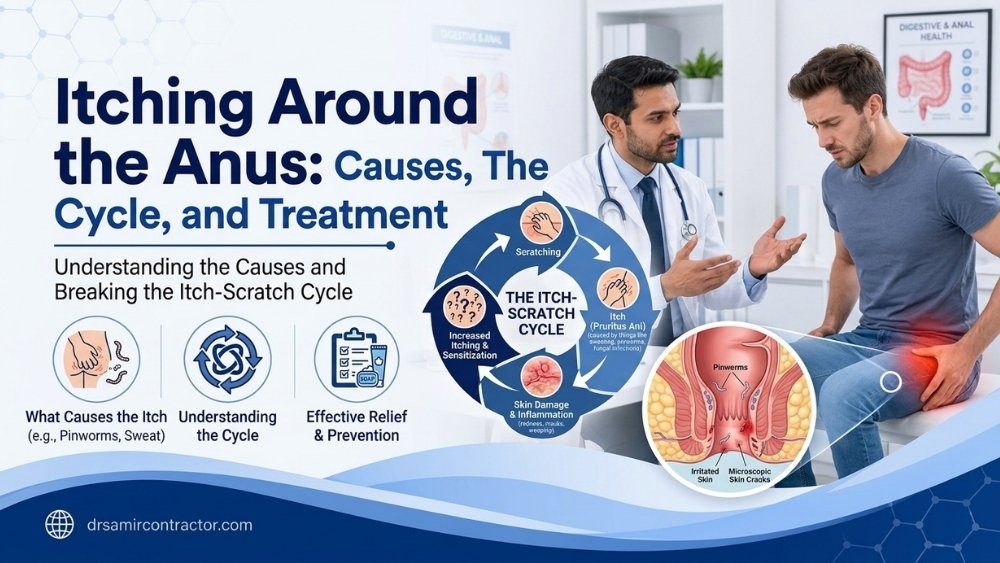
Persistent itching around the anus is one of the most common - and most embarrassing - complaints patients hesitate to discuss. In most cases the cause is straightforward: moisture, irritation, or a treatable condition like piles. This guide explains why the itch starts, why it keeps coming back, and exactly how to break the cycle.
Quick Answers
You would not be reading this page if the itch were not bothering you. That is completely understandable - and you are far from alone. Pruritus ani affects an estimated 1 to 5 percent of the adult population, with men affected roughly four times more often than women. Many patients wait months or even years before raising the topic with a doctor, often because they feel embarrassed or assume it is a hygiene problem they should solve on their own.
The reality is usually simpler and more fixable than patients expect. This page walks you through what pruritus ani actually means, the conditions that trigger it, the cycle that keeps it going, and the practical steps that end it. If you need the formal disease overview, our dedicated pruritus ani page covers the clinical classification and grading in greater detail.
What Does Pruritus Ani Mean?
Pruritus ani is the medical term for itching around the anus. "Pruritus" means itch; "ani" refers to the anus. It is not a diagnosis in itself - it is a symptom. The itching can be limited to a small patch of skin right at the anal margin, or it can extend outward to the surrounding buttock skin. Some patients describe it as itching; others use words like burning, stinging, or a crawling sensation.
Doctors classify it into two groups:
- Secondary pruritus ani - a specific, identifiable cause exists (piles, fissure, infection, skin disease). This accounts for roughly 50 to 75 percent of cases.
- Idiopathic (primary) pruritus ani - no single cause is found after examination. Often related to moisture, dietary irritants, or an overactive itch-scratch cycle that has become self-sustaining.
The good news: both types respond well to treatment once the cycle is interrupted and the trigger is addressed.
Common Causes of Itching Around the Anus
Perianal skin is thinner and more sensitive than skin almost anywhere else on the body. It sits in a warm, enclosed space with limited airflow. Any factor that increases moisture, friction, or chemical exposure on this skin can start the itch. Below are the causes seen most frequently in clinical practice.
1. Hemorrhoids (Piles) and Mucus Leakage
Prolapsing internal hemorrhoids produce mucus that seeps onto the perianal skin. This constant dampness breaks down the skin barrier and triggers itching - often the primary reason a patient with grade II or III piles visits a surgeon. Treating the piles stops the mucus, and the itch resolves. Learn more on our hemorrhoids (piles) page.
2. Poor Hygiene After Bowel Movements
Residual stool left on the perianal skin after incomplete wiping causes chemical irritation. This is especially common after loose stools, when wiping alone may not be sufficient.
3. Excess Hygiene - The Opposite Extreme
Scrubbing with soap, using antiseptic washes (Dettol, Savlon), or wiping aggressively with rough toilet paper strips the natural oils from perianal skin. The resulting dryness and micro-abrasions trigger more itch, prompting more cleaning - a vicious circle. In Indian households, strong soap use on the perianal area is one of the most under-recognised drivers.
4. Fungal Infection (Candida or Dermatophyte)
The warm, moist perianal fold is a prime location for fungal growth. Candida (yeast) and tinea (ringworm-type fungus) produce well-defined, red, scaly patches with intense itching. These are common in diabetics, in patients on antibiotics, and during the Indian summer months.
5. Skin Conditions - Eczema, Psoriasis, Contact Dermatitis
Conditions that affect skin elsewhere on the body can also affect the perianal area. Contact dermatitis from fragranced wet wipes, medicated creams, or laundry detergent residue in undergarments is surprisingly frequent.
6. Anal Fissure
A small tear in the anal lining causes pain during stool, but it can also cause a low-grade itch between bowel movements as the fissure heals and re-tears. See our anal fissure guide for more detail.
7. Anal Fistula and Perianal Discharge
A fistula tract that drains pus or mucus onto the perianal skin causes chronic moisture and irritation. Patients often notice a persistent damp patch in their undergarments alongside the itch. Read more on our pus and discharge near the anus and anal fistula pages.
8. Pinworm (Threadworm) Infection
Common in children but not rare in adults. The female pinworm migrates to the anal margin at night to lay eggs, causing intense nocturnal itching. A simple tape test or empirical treatment with a single dose of albendazole confirms and resolves it.
9. Dietary Triggers
Certain foods and drinks change the chemical composition of stool or produce loose motions that irritate perianal skin. The most commonly reported triggers include:
- Coffee - relaxes the internal anal sphincter and increases mucus
- Spicy food - capsaicin is not fully absorbed and directly irritates the anal canal
- Citrus fruits - acidic residue in stool
- Alcohol - causes looser stools and increased perianal moisture
- Tomatoes, chocolate, dairy - reported triggers in some patients
The Itch-Scratch Cycle: Why It Keeps Coming Back
Understanding this cycle is the key to understanding why the problem persists. The perianal skin is so thin that even light scratching through clothing causes micro-damage. Damaged skin releases histamine and inflammatory chemicals. These chemicals trigger more itch. The patient scratches again, often unconsciously during sleep, and the cycle deepens.
The Itch-Scratch Cycle
Itch ➔ Scratch ➔ Skin Damage ➔ Inflammation ➔ More Itch ➔ More Scratching
Over weeks, the perianal skin thickens (lichenification), nerve endings become hypersensitive, and the itch fires even without a clear trigger. At this stage, the cycle sustains itself.
This is why patients say "it went away for a few days, then came right back." The original cause (say, a short bout of loose stools) has resolved, but the damaged skin and sensitised nerves continue the cycle independently.
Red Flags - When Anal Itching Needs Urgent Attention
- A visible lump, ulcer, or non-healing sore near the anus
- Bleeding alongside the itch - especially if painless
- Pus or foul-smelling discharge from a perianal opening
- Rapid, unexplained weight loss or change in bowel habit
- Itch that has not improved after 4 weeks of basic measures
- Skin changes that look white, thickened, or pigmented
Any of these findings warrant an in-person examination. They do not necessarily mean something dangerous, but they require a proper assessment to rule out a fissure, fistula, or - very rarely - a perianal skin lesion.
Reassuring Signs
- Itch appeared after a change in soap, wipes, or laundry detergent
- Symptoms are clearly worse after coffee, spicy food, or alcohol
- No lump, bleeding, or discharge on self-examination
- Itch improves within days of stopping a specific product
- Known history of piles or eczema that explains the symptom
These patterns suggest a benign, correctable cause. Simple measures described below will usually resolve the itch within 2 to 4 weeks.
How Is the Cause Diagnosed?
Diagnosis begins with a focused history: when the itch started, what makes it worse, what products you use, what you eat, and whether there is any associated bleeding or discharge. A brief external and digital rectal examination follows. In most cases, a proctoscopy (a 2-minute look inside the anal canal with a small scope) is enough to identify piles, a fissure, or a fistula opening.
If a fungal infection is suspected, a simple skin scraping confirms it. If the skin looks abnormal, a small biopsy can be taken under local anaesthesia. Blood sugar testing is worthwhile because uncontrolled diabetes is a silent driver of recurrent fungal perianal infection.
Treatment: How to Break the Cycle and Stop the Itch
Treatment works on three levels: break the itch-scratch cycle, treat the underlying cause, and restore the skin barrier. Most patients see significant improvement within two weeks.
Step 1 - Break the Itch-Scratch Cycle
- Stop scratching - this is the hardest but most important step. Wear cotton gloves at night if you scratch in your sleep.
- Keep nails trimmed - short nails cause less skin damage.
- Pat, never rub - after washing, pat the area dry with a soft towel or use a hair dryer on cool setting.
- Antihistamine at bedtime - cetirizine or hydroxyzine reduces the nocturnal itch urge and helps you sleep through without scratching.
Step 2 - Topical Measures
- Barrier cream - a thin layer of zinc oxide or petroleum jelly protects healing skin from stool contact and moisture.
- Short-course mild steroid - a low-potency hydrocortisone cream (1%) for 5 to 7 days calms inflammation and resets the itch threshold. Never use strong steroids or continue beyond two weeks without medical guidance - they thin the skin and worsen the problem long-term.
- Antifungal cream - clotrimazole or miconazole if fungal infection is confirmed or strongly suspected.
- Avoid medicated or fragranced products - no Dettol, no wet wipes with alcohol, no perfumed soap. Plain water is best.
Step 3 - Dietary Modification
- Reduce coffee to one cup a day or eliminate it temporarily.
- Cut back on very spicy food for 2 to 3 weeks and observe.
- Limit alcohol, citrus, and tomato-heavy dishes during the flare.
- Increase fibre and water to keep stools soft and formed - this reduces wiping trauma.
Step 4 - Treat the Underlying Condition
If piles are the source, treating the hemorrhoids (banding, laser, or surgical excision) stops the mucus leak and cures the itch. If a fissure is responsible, healing the fissure ends the problem. A draining fistula needs definitive surgical repair. Without addressing the root cause, topical measures provide only temporary relief.
What Happens If Anal Itching Is Ignored?
- Lichenification - the perianal skin becomes thick, leathery, and permanently hypersensitive, making the itch far harder to treat later.
- Secondary bacterial infection - broken skin from scratching becomes infected, producing pain, redness, and sometimes abscess formation.
- Chronic sleep disruption - nocturnal itching causes fragmented sleep, daytime fatigue, and irritability over months.
- Missed underlying cause - a fissure, fistula, or (rarely) an early perianal lesion that would have been easily treated at the start can progress if overlooked.
- Psychological burden - the embarrassment, social withdrawal, and anxiety associated with constant itching should not be underestimated.
The earlier you address it, the faster it resolves. Most patients wish they had spoken up sooner.
Anal Itching Context in India
Why Anal Itching Is Especially Common in India
- Hot, humid climate - prolonged sweating in the perianal fold creates the perfect environment for fungal growth and moisture-related irritation, particularly between March and October.
- Tight synthetic clothing - non-cotton undergarments and tight jeans trap heat and moisture against the skin. Cotton undergarments with a looser fit make a measurable difference.
- Spice-heavy diet - Indian cuisine uses generous amounts of chilli, which contains capsaicin that passes partially undigested into the stool, directly irritating the anal canal and perianal skin.
- Over-the-counter cream overuse - patients frequently self-treat with strong steroid or combination (steroid + antifungal + antibiotic) creams purchased without prescription. Initial relief is followed by skin thinning, rebound itch, and sometimes steroid-dependent dermatitis - making the problem far worse.
- Aggressive washing with soap - the cultural emphasis on cleanliness often leads to vigorous scrubbing of the perianal area with antiseptic solutions, stripping the skin's protective oils.
Anal Itching Treatment in Vadodara
Dr Samir Contractor evaluates perianal itching at Sterling Hospital, Vadodara. The first visit includes a focused history, a gentle clinical examination, and proctoscopy if needed - all in one appointment. If piles, fissure, or fistula is identified as the source, treatment options are discussed the same day. Fungal or skin-related causes are treated with a targeted prescription rather than over-the-counter combination creams.
Many patients feel awkward discussing this symptom. Rest assured - this is one of the most common complaints we see in anorectal practice. No embarrassment, no judgement, just a practical solution.
ગુજરાતી માં પૂછાતા પ્રશ્નો (Gujarati / Hinglish FAQs)
Ghana cases ma piles na mucus thi bheenapanu rahe chhe, je skin ne irritate kare chhe. Bija karano ma fungal infection, fissure, dietary triggers jevi ke coffee ane tikhu, ane vadhu padtu washing pan chhe.
Blanket ni neeche garmi ane bheenapanu vadhe chhe, ane man divert thatu nathi to khujli nu dhyan vadhu lagge chhe. Pinworm hoy to te ratre active thay chhe.
Na. Dettol ane strong sabun skin na natural tel kadhi nakhe chhe ane khujli vadhu kare chhe. Sadu pani j best chhe, ke mild fragrance-free soap.
Ghana OTC cream ma strong steroid hoy chhe. Pahelaa relief aape chhe, pan skin patli thay chhe ane cream band karo etle khujli parat aave chhe - vadhu kharab. Aa steroid-dependent dermatitis chhe, ane doctor ni guidance thi j ukelvu joiye.
Ha, jyo piles na mucus thi khujli hoy, tyaan piles no ilaaj - banding, laser, ke surgery - mucus band kare chhe ane khujli jati rahe chhe.
Motha bhag na cases ma nahi. Examination ane proctoscopy thi karan khabar padi jay chhe. Colonoscopy tyaare j jaruri chhe jyaare bleeding, weight loss, ke bowel habit badlayo hoy.
Tired of the Itch? Get a Clear Answer.
A single consultation is usually enough to identify the cause and start the right treatment. Most patients see improvement within two weeks.