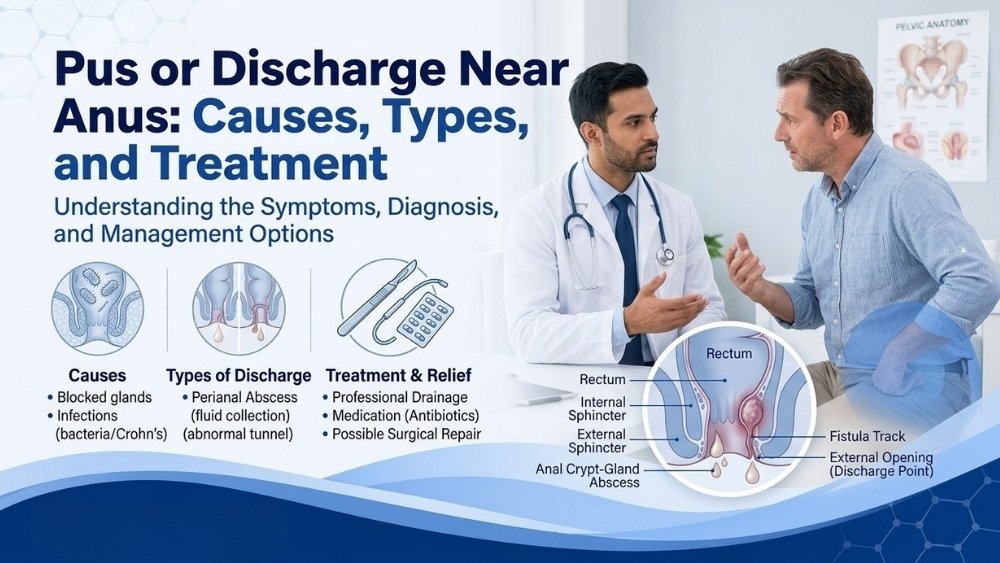
Finding pus or an unfamiliar discharge on your underwear is alarming - and understandably embarrassing. You are not alone: this is one of the most common anorectal complaints, yet one of the least talked about. The discharge itself is a signal, not a disease. It almost always points to a treatable underlying condition, most commonly an anal fistula or a draining perianal abscess. This page explains what different types of discharge mean, what causes them, and what steps to take next.
Quick Answers
You notice a damp spot on your underwear. Or a small stain that was not there yesterday. Perhaps there is an odour you cannot explain. Your first instinct may be to ignore it, hoping it was a one-time occurrence. But when it happens again - the next day, or the next week - the worry sets in. What is this discharge? Where is it coming from? Is something seriously wrong?
These concerns are completely valid, and the embarrassment many patients feel is one of the biggest reasons they delay seeking help. In clinical practice, it is common to see patients who have been living with perianal discharge for months or even years before finally consulting a surgeon. This delay often transforms a straightforward problem into a more complicated one. Understanding what the discharge means is the first step toward getting it resolved.
What Does Discharge Near the Anus Actually Mean?
Discharge near the anus is a symptom, not a diagnosis. It tells you that somewhere in the anorectal region, there is a source of fluid - whether pus from an infection, mucus from inflamed tissue, or blood-stained fluid from a wound or lesion. The character of the discharge (its colour, consistency, smell, and pattern) provides important clues about its origin.
In most cases, the discharge originates from one of two places: a tract or tunnel connecting the anal canal to the outside skin (a fistula), or a cavity filled with infected material (an abscess) that has found or made a path to the skin surface. Less commonly, the source is the anal canal lining itself - inflamed hemorrhoids, an infection, or an inflammatory condition.
Types of Discharge: Pus vs Mucus vs Blood-Tinged
Not all discharge is the same. Recognising the type can help your surgeon narrow down the diagnosis even before the examination.
| Type of discharge | Appearance | What it typically suggests |
|---|---|---|
| Pus (purulent) | Yellow, greenish, or creamy fluid; often foul-smelling | Active infection - anal fistula, draining abscess, or infected pilonidal sinus |
| Mucus | Clear or whitish, jelly-like, typically odourless | Inflamed internal hemorrhoids (prolapsing piles), rectal prolapse, or mucous discharge from the lower rectum |
| Blood-tinged | Pink, reddish-brown, or streaked with blood | Granulation tissue in a healing abscess cavity, fistula tract irritation, or an underlying fissure |
| Watery / serous | Thin, clear or straw-coloured fluid | Early fistula, chronic wound drainage, or perianal skin condition (eczema, fungal infection) |
Common Causes of Pus or Discharge Near the Anus
Anal Fistula - The Most Common Cause of Persistent Discharge
An anal fistula is an abnormal tunnel that forms between the inside of the anal canal and the skin near the anus. It almost always develops as the aftermath of a perianal abscess. Once the abscess drains (either spontaneously or surgically), the tract it created may fail to heal and becomes a permanent channel. Infected material from the anal glands continues to drain through this tract, producing the characteristic intermittent or continuous pus discharge.
The pattern is distinctive: the discharge may stop for days or weeks when the external opening seals over, then pressure builds up inside, the area becomes painful and swollen, and the discharge resumes - often with a sense of relief. This on-and-off cycle is one of the strongest indicators of a fistula.
Perianal Abscess - Acute Pus Discharge
A perianal abscess is a collection of pus in the tissue beside the anus. When the abscess is pointing toward the skin surface, it may rupture spontaneously, producing a sudden gush of pus and immediate partial relief of pain. However, spontaneous drainage is usually incomplete - the deeper cavity remains, and the cycle of accumulation and discharge continues. Proper surgical drainage is needed to fully resolve the infection and prevent fistula formation.
Pilonidal Sinus
A pilonidal sinus is a chronic infection in the natal cleft (the crease between the buttocks), typically a few centimetres above the anus. It is caused by hair follicles becoming embedded under the skin, creating a sinus tract that intermittently discharges pus. While technically not at the anus itself, patients often describe it as discharge "near the anus" because of the proximity. It is especially common in young men with thick body hair and sedentary occupations.
Mucus Discharge from Hemorrhoids (Piles)
Prolapsing internal hemorrhoids (Grade III and IV) can produce mucus discharge. The exposed mucosal surface secretes mucus onto the perianal skin, causing persistent dampness, staining, and itching around the anus. This discharge is typically clear or whitish and non-foul-smelling - it is mucus, not pus. However, it causes significant discomfort and skin irritation over time.
Sexually Transmitted Infections (STIs)
Infections such as gonorrhoea, chlamydia, and herpes simplex can cause discharge from the anal canal, particularly in patients who have had receptive anal intercourse. The discharge may be purulent (gonorrhoea), mucoid (chlamydia), or associated with painful ulcers (herpes). If an STI is suspected, specific swabs and testing are arranged.
Crohn's Disease - A Less Common but Important Cause
Patients with Crohn's disease may develop perianal fistulae, abscesses, and chronic discharge as part of their condition. If perianal discharge is accompanied by chronic diarrhoea, abdominal pain, or weight loss, Crohn's disease should be considered, and a gastroenterology referral may be appropriate alongside surgical management.
When Should You Seek Urgent Care?
See a Surgeon the Same Day If
- Discharge is accompanied by fever (above 100.4 F / 38 C): this suggests an active, undrained abscess that needs surgical drainage
- The area is becoming increasingly swollen and painful: the abscess may be expanding and could track into deeper tissue planes
- You notice large amounts of pus draining suddenly: an abscess has ruptured - surgical assessment is still needed even though some pressure has been relieved
- You have diabetes or are immunocompromised: infections spread faster and heal slower in these patients; early intervention is critical
- You are unable to sit, walk, or carry out daily activities due to pain and discharge: the condition has progressed beyond conservative management
Red Flags That Need Prompt Evaluation (Within a Week)
- Discharge that has persisted for more than 2 weeks without improvement
- Recurrent episodes of swelling, pain, and discharge at the same site
- Blood-stained discharge from the anal area, especially if accompanied by changes in bowel habit or weight loss
- Multiple external openings visible on the perianal skin
- Discharge accompanied by chronic diarrhoea or abdominal symptoms (raises concern for Crohn's disease)
Usually Safe to Wait for a Planned Appointment
- Small amounts of clear mucus on wiping, with no pain or fever - likely from internal piles
- Occasional minor dampness around the anus without visible pus - may be perianal moisture or mild dermatitis
- A known fistula already under follow-up that continues to drain small amounts between appointments
- Post-operative discharge from a healing abscess drainage wound (expected for several weeks after surgery)
Even mild discharge deserves a one-time assessment to confirm the cause. The earlier a fistula is identified, the simpler the surgery.
How Is the Cause of Anal Discharge Diagnosed?
The examination is brief, private, and far less uncomfortable than most patients expect. Dr Samir Contractor follows a structured approach:
- Clinical examination: The perianal skin is inspected for external openings, skin changes, and the character of the discharge. A gentle digital rectal examination checks for internal openings, induration (hardness indicating a tract), and tenderness. This clinical assessment alone identifies the cause in the majority of cases.
- MRI fistulogram: The gold standard for mapping fistula tracts. The MRI shows the course of the tract, its relationship to the sphincter muscles, any secondary branches, and hidden abscess cavities. This information is essential for planning surgery that cures the fistula while protecting continence.
- Examination under anaesthesia (EUA): For complex fistulae or cases where the tract cannot be fully defined on MRI, an EUA is performed. Under general anaesthesia, the surgeon probes the tract, identifies all openings, and may place a draining seton (a loose thread through the tract) as the first stage of treatment.
Additional tests may include:
- Blood tests: Complete blood count and blood sugar - especially if infection is present or diabetes is suspected.
- Swabs for STI testing: If the history suggests a sexually transmitted cause.
- Colonoscopy: If Crohn's disease is suspected based on symptoms or the pattern of fistulae.
Treatment
Anal Fistula
A fistula will not heal permanently with antibiotics or dressings alone. Surgery is needed to either lay open the tract (fistulotomy) or close it using sphincter-preserving techniques. The choice depends on how much sphincter muscle the tract crosses:
- Simple, low fistula: Fistulotomy - the tract is laid open and allowed to heal from the base. High cure rate, minimal recovery time.
- Complex or high fistula: Sphincter-preserving techniques such as the LIFT procedure (ligation of intersphincteric fistula tract), VAAFT (video-assisted anal fistula treatment), or advancement flap. These approaches protect the anal sphincter to maintain continence.
- Staged approach: For very complex fistulae, a draining seton is placed first to control infection, followed by definitive repair after inflammation settles.
Visit our fistula surgery page for detailed information on each technique.
Perianal Abscess
- Incision and drainage - the definitive first step. The abscess cavity is opened, pus is drained, and the wound is left open to heal from the inside out.
- Antibiotics are given alongside drainage, not as a replacement. They are especially important in diabetic or immunocompromised patients.
- Follow-up is essential: 30 to 50% of drained abscesses go on to develop a fistula tract, which may need further surgery.
Pilonidal Sinus
- Acute infection is drained first, then the sinus tract is excised once inflammation settles.
- Various techniques are available - from wide excision with healing by secondary intention to flap-based closures for recurrent disease.
- See our pilonidal sinus surgery page for details.
Hemorrhoid-Related Mucus Discharge
- Treating the underlying prolapsing hemorrhoids stops the mucus production.
- Options include laser hemorrhoidectomy, stapler hemorrhoidopexy, or conventional excision depending on the grade and number of piles.
STI-Related Discharge
- Appropriate antibiotics or antiviral medication based on test results.
- Partner notification and testing are important to prevent reinfection.
What Happens If Pus Discharge Is Ignored?
- Simple fistula becomes complex. A fistula with a single tract, if left untreated for months, can develop secondary branches, horseshoe extensions, or multiple external openings. What could have been a 30-minute fistulotomy may then require staged surgery over several months.
- Recurrent abscess formation. Each time the external opening of a fistula seals over, pus accumulates under pressure and a new abscess forms. Each episode causes more scarring, more tissue damage, and more complex anatomy for the surgeon to deal with.
- Chronic skin damage. Persistent discharge irritates the perianal skin, causing contact dermatitis, maceration (skin breakdown from constant moisture), and secondary fungal infection. The resulting itching adds another layer of discomfort.
- Impact on daily life. Patients with chronic discharge describe needing to change pads or underwear multiple times a day, avoiding social situations, and constant anxiety about odour. The psychological burden is real and often underestimated.
- Deeper infection spread. An undrained abscess can extend from the perianal space into the ischiorectal fossa or above the pelvic floor (supralevator abscess). These deep collections require more invasive drainage and carry higher risks.
- Missed underlying disease. Chronic perianal discharge can occasionally be the first sign of Crohn's disease or, very rarely, an anal canal malignancy. Persistent symptoms that are never investigated mean these conditions are caught later rather than sooner.
Why This Matters in India
Perianal discharge is one of the most under-reported surgical symptoms in India. The reasons are specific to our cultural context:
- Stigma and silence. Discussing discharge from the anal area is extremely difficult for many patients. Men and women both delay for months, often trying home remedies, Ayurvedic ointments, or over-the-counter antibiotics before seeking surgical opinion. By the time they present, a simple fistula has often become complex.
- Self-medication with antibiotics. Antibiotics are available without prescription across much of India. Patients take repeated courses that temporarily reduce the discharge but never address the underlying tract. This gives a false sense of improvement while the fistula quietly becomes more established.
- Fear of "fistula surgery." There is widespread fear - partly justified by older surgical techniques - that fistula surgery means long hospital stays and risk of incontinence. Modern sphincter-preserving techniques (LIFT, VAAFT, laser) have substantially reduced these risks, but awareness remains low.
- Dietary factors. A diet high in refined flour, fried snacks, and low in fibre contributes to constipation and hard stools, which worsen any anorectal condition and impair wound healing after abscess drainage.
Anal Discharge Treatment in Vadodara
Dr Samir Contractor evaluates and treats all causes of perianal discharge at Sterling Hospital, Race Course Road, Vadodara. From same-day abscess drainage to planned fistula surgery using advanced sphincter-preserving techniques, the full diagnostic and treatment pathway is available under one roof. MRI fistulogram, EUA, and definitive surgery can all be coordinated through a single consultation.
Desi Patient Questions (Gujarati / Hinglish)
Mota bhag na case ma aa fistula hoy chhe - anal canal thi chamdi sudhi ek nani nali hoy chhe jema thi pus nikale chhe. Abscess (pus no gathho), pilonidal sinus, ke piles ma thi mucus pan hoy shake. Doctor ne ekvaar batavvu jaruri chhe - joyu joyu thi khabar na padhe.
Haa, jarur. Fistula ma ghani vaar dard ochu hoy chhe pan pus nikaltunu band nathi thatu. Dard na hoy ae na bolvu ke problem nathi - nali (tract) to chhe j. Jeta moda karsho, aeta complicated thase.
Nahi. Antibiotic thi infection thodi ghat thaay pan fistula ni nali band nathi thati. Thoda divas pachi paachhu pus nikalvanu sharu thase. Kaya mathi nali band karvi hoy to surgery j jaruri chhe.
Aa ek special MRI scan chhe je fistula ni nali no aakhho rasto batave chhe - kya thi sharu thay chhe, kya sudhi jaay chhe, ane koi chhupayelu abscess chhe ke nahi. Surgery pahela aa karvu bahuj jaruri chhe jeethi surgeon sachi plan kari shake.
Saadhi fistulotomy pachi 5-7 divas ma desk work sharu kari shakay. LIFT ke VAAFT jevi advanced surgery pachi pan recovery similar hoy chhe. Puro wound 4-6 aathvadia ma bhraay chhe. Sitz bath ane dressing regular rakhvo.
Discharge thi chamdi bhini rahe chhe ane ae thi kharash thay chhe. Chamdi ne sukhi rakhvo - cotton pad rakhvo, vaaramvaar badhalvo. Pan kharash kalami bandh karvani hoy to discharge nu karan - fistula ke piles - ae treat karvu padse. Cream thi temporary rahat maale pan kalami upay nahi.
Dealing with Discharge Near Your Anus?
You do not have to manage this alone or in silence. A brief, private examination identifies the cause and sets the treatment plan. Most patients wish they had come sooner.