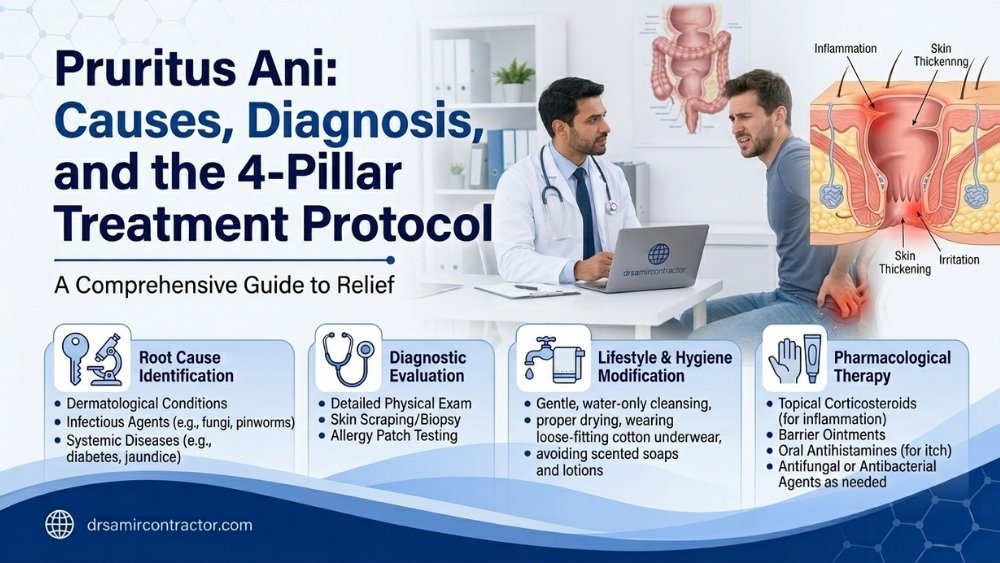
In plain language: Pruritus ani is the medical diagnosis for a persistent, overwhelming urge to scratch the skin around the anus. It is not just "an itch" - it is a recognised clinical condition. It is most often caused by moisture (from piles or sweating), fungal infection, or a damaged skin barrier. Left untreated, it creates a vicious itch-scratch cycle that damages the skin and ruins sleep. It is highly treatable once the specific cause is identified and the cycle is broken.
Quick Answer
Chronic Itch That Will Not Settle?
A focused perianal examination identifies the cause. Most patients leave their first visit with a clear treatment plan.
If you have been dealing with anal itching for weeks or months, you have probably tried creams from the pharmacy, changed your soap, and searched online more times than you care to admit. The fact that you have reached a page about pruritus ani - the disease - rather than just "itching around the anus" suggests the problem has not gone away with simple measures. That is exactly what this page is for.
Pruritus ani is not just an annoying symptom. It is a recognised clinical entity with a classification system, a grading scale, and a treatment protocol. Understanding the condition at this level is the first step toward ending it. If you are looking for a general overview of perianal itching and its common triggers, our companion itching around the anus symptom page is a good starting point. This page goes deeper into the disease itself.
What Is Pruritus Ani? Primary vs Secondary
Pruritus ani literally translates to "itching of the anus." In clinical practice, the term refers to a condition - not merely a complaint - where the perianal skin is caught in a cycle of irritation, scratching, skin damage, and further irritation. The condition is common, affecting an estimated 1 to 5 percent of the general adult population. Men are affected roughly four times more often than women, and the peak incidence falls between ages 40 and 60.
Surgeons and dermatologists divide pruritus ani into two categories:
Secondary Pruritus Ani (50-75% of Cases)
A specific, identifiable cause is present. Once that cause is treated, the itching resolves. Common secondary causes include:
- Hemorrhoids (piles) - prolapsing internal piles produce mucus that keeps the perianal skin perpetually damp, breaking down the skin barrier. This is the single most common anorectal cause. See our hemorrhoids page.
- Anal fissure - a small tear in the anal lining causes a low-grade itch between bowel movements as the wound attempts to heal. More on our anal fissure page.
- Anal fistula and perianal discharge - chronic pus or mucus drainage from a fistula tract creates a constantly moist environment. See pus and discharge near the anus.
- Fungal infection - Candida (yeast) and dermatophyte (tinea) infections thrive in the warm, moist perianal fold, producing well-defined red patches with intense itch. Particularly common in diabetic patients and during the Indian summer.
- Skin conditions - perianal eczema, psoriasis, lichen sclerosus, and seborrhoeic dermatitis can all present with isolated perianal itching before appearing elsewhere.
- Contact dermatitis - fragranced wet wipes, medicated creams (especially those containing neomycin or benzocaine), scented soaps, and detergent residue in undergarments are frequent culprits.
- Pinworm (threadworm) infection - the female pinworm migrates to the anal margin at night to deposit eggs, causing intense nocturnal itching. Common in children but not rare in adults. A single dose of albendazole cures it.
Primary (Idiopathic) Pruritus Ani (25-50% of Cases)
No single cause is found on examination. In these patients, the itch is typically maintained by a combination of:
- The self-perpetuating itch-scratch cycle (explained below)
- Dietary triggers - coffee, tea, cola, citrus fruits, tomatoes, chocolate, spicy food, beer, and dairy products can alter stool chemistry or relax the internal anal sphincter, allowing micro-leakage of stool that irritates the perianal skin
- Hygiene extremes - both under-cleaning (residual stool) and over-cleaning (soap stripping natural oils) can initiate and maintain the condition
- Moisture trapping - tight synthetic underwear, prolonged sitting, and obesity create a warm, damp environment that promotes skin breakdown
In practice, many patients with "idiopathic" pruritus ani turn out to have a subtle dietary or hygiene trigger that becomes apparent only after a structured elimination process.
The Itch-Scratch-Itch Cycle
The Self-Perpetuating Cycle
Irritation / Trigger → Itch Signal → Scratching → Skin Damage & Inflammation → More Itch → More Scratching → Chronic Skin Changes
Understanding this cycle is central to treating pruritus ani. The perianal skin is among the thinnest on the body. When you scratch - even gently, even through clothing - you create micro-tears. These tears trigger an inflammatory response: the skin becomes red, swollen, and produces histamine, which generates more itch. The brain interprets the itch as unbearable, you scratch again, and the damage deepens.
Over weeks and months, this cycle produces visible skin changes: the perianal skin thickens, develops a pale or greyish colour, and forms exaggerated skin folds. Surgeons call this lichenification. At this stage the itch has become self-sustaining - even if the original trigger (say, mucus from piles) is removed, the thickened skin itself continues to itch. This is why treatment must address both the trigger and the cycle.
Grading Pruritus Ani: Mild, Moderate, Severe
Your surgeon grades the condition based on the appearance of the perianal skin during examination. This grading guides treatment intensity.
| Grade | Skin Appearance | Symptoms | Treatment Focus |
|---|---|---|---|
| Mild | Normal or slightly red skin; no visible thickening | Intermittent itch, worse after bowel movement or at night | Hygiene + dietary modification; barrier cream |
| Moderate | Red, inflamed skin with early excoriation (scratch marks); mild skin thickening beginning | Daily itch; sleep occasionally disrupted; noticeable urge to scratch | Hygiene + diet + short-course topical steroid + barrier cream; investigate underlying cause |
| Severe | Lichenified (thickened, pale/grey) skin with deep excoriations, fissuring, or secondary infection | Constant itch; sleep regularly disrupted; significant impact on daily life | Full 4-pillar protocol; treat underlying cause surgically if present; consider dermatology co-management |
How Is Pruritus Ani Diagnosed?
Diagnosis is primarily clinical - it relies on a careful history and a focused perianal examination rather than expensive tests.
Step 1: Focused History
- Duration and pattern of itching (constant vs intermittent, day vs night)
- Relationship to bowel movements, specific foods, or products
- Hygiene routine - type of soap, wiping method, use of wet wipes or antiseptics
- Previous treatments tried and their effect
- History of piles, fissure, fistula, diabetes, or skin conditions elsewhere
Step 2: Perianal Examination
A careful visual inspection of the perianal skin under good light reveals the grade of skin change, the distribution of redness or lichenification, and any signs of an underlying cause (prolapsing pile, fissure, fistula opening, fungal plaque, or skin lesion).
Step 3: Proctoscopy
A short, painless examination using a proctoscope checks for internal hemorrhoids, rectal mucosal prolapse, or an internal fissure that may not be visible externally.
Step 4: Targeted Investigations (When Needed)
- Skin scraping / swab - if fungal or bacterial infection is suspected
- Tape test - for pinworm, done first thing in the morning
- Patch testing - if contact dermatitis is suspected (done by a dermatologist)
- Biopsy - reserved for atypical, non-healing, or asymmetric skin lesions to exclude rare perianal pathology
The 4-Pillar Treatment Protocol
Treatment of pruritus ani is structured and methodical. Each pillar addresses a different part of the problem. Skipping any one pillar is the most common reason for treatment failure.
Pillar 1: Perianal Hygiene Protocol
- Wash with plain water only - no soap, no Dettol, no antiseptic liquid on the perianal skin. A mild, fragrance-free cleanser may be used if needed, but water alone is best.
- Pat dry, never rub - use soft toilet paper or a clean cotton cloth to pat the area completely dry after washing. Residual moisture is one of the biggest perpetuating factors.
- Avoid aggressive wiping - a bidet or hand-held spray followed by gentle patting is preferred over repeated wiping with dry paper.
- Wear loose, cotton underwear - synthetic fabrics trap heat and moisture. Change underwear daily and after exercise.
- Avoid scratching - keep nails short. At night, wear light cotton gloves if you scratch in your sleep.
Pillar 2: Dietary Trigger Elimination
A structured elimination trial removes the most common dietary triggers for 2 to 3 weeks, then reintroduces them one at a time. The key triggers to eliminate:
- Coffee and caffeine (the single most common dietary trigger)
- Citrus fruits - oranges, lemon, grapefruit
- Tomatoes and tomato-based sauces
- Spicy food - chillies, pepper, hot sauces
- Chocolate
- Beer and alcohol
- Cola and carbonated drinks
- Dairy - in patients with suspected sensitivity
If the itch improves during the elimination period, foods are reintroduced individually at 3-day intervals to identify the specific trigger. Many patients find that reducing - not necessarily eliminating - the offending item is sufficient.
Pillar 3: Topical Care
- Barrier cream - a thin layer of zinc oxide-based cream (such as calmoseptine or a plain zinc barrier ointment) applied after every wash. This protects the healing skin from moisture and stool contact.
- Short-course topical steroid - in moderate to severe cases, a low-potency steroid (1% hydrocortisone) applied twice daily for 2 weeks breaks the inflammatory component of the cycle. This is not a long-term treatment.
- Antifungal cream - if fungal infection is confirmed on examination, a topical antifungal (clotrimazole or miconazole) is used for 2 to 4 weeks.
- Antihistamine at bedtime - an oral sedating antihistamine (such as hydroxyzine) reduces nocturnal scratching during the first 1 to 2 weeks of treatment.
A note on pharmacy creams: Many over-the-counter perianal creams available in India combine a potent steroid with an antifungal and antibiotic in a single tube. These provide rapid relief, but prolonged use (beyond 2 weeks) thins the perianal skin and causes steroid-dependent dermatitis - the itch returns worse than before when you stop. Never use combination steroid creams for more than 2 weeks without medical supervision.
Pillar 4: Treat the Underlying Cause
If examination reveals a specific secondary cause, treating it is essential:
- Hemorrhoids producing mucus - rubber band ligation, laser treatment, or surgical hemorrhoidectomy. Learn more: hemorrhoid surgery.
- Anal fissure - topical diltiazem or glyceryl trinitrate ointment; lateral internal sphincterotomy if conservative treatment fails. See: fissure surgery.
- Anal fistula - surgical management (fistulotomy, seton, or LIFT procedure) to eliminate the discharging tract.
- Fungal infection - topical antifungal for 2 to 4 weeks; oral fluconazole if extensive.
- Pinworm - single dose of albendazole (400 mg), repeated after 2 weeks. Treat all household members simultaneously.
- Contact dermatitis - identify and eliminate the offending product.
- Skin condition (eczema, psoriasis) - dermatology co-management for steroid-sparing maintenance therapy.
Red Flags - See a Doctor Promptly
- Perianal itching with bleeding that is not clearly from piles
- A visible non-healing ulcer or lump at the anal margin
- Asymmetric skin change - thickening or discolouration on one side only
- Itch accompanied by weight loss or change in bowel habit
- Pus or foul-smelling discharge alongside the itch
- Itch that worsens despite 3 to 4 weeks of structured treatment
- Spreading redness with fever - suggests secondary infection
Reassuring Signs
- Itch that started recently and is clearly linked to a dietary change or new product
- Symmetric redness around the anus without any lump or ulcer
- Itch that improves with basic hygiene measures within the first 1 to 2 weeks
- Known history of piles, fissure, or fungal infection that explains the itch
- No bleeding, no weight loss, no change in bowel habit
What Happens If Pruritus Ani Is Ignored?
Pruritus ani is not dangerous in itself, but ignoring it allows the itch-scratch cycle to cause progressive skin damage:
- Lichenification - the perianal skin thickens, turns pale or greyish, and develops exaggerated folds. Once established, lichenified skin itches on its own, even after the original trigger is gone. Reversal takes weeks to months of careful treatment.
- Secondary bacterial infection - repeated scratching breaks the skin barrier, allowing bacteria to enter. This can cause perianal cellulitis (spreading redness, warmth, pain) or superficial abscess formation that requires antibiotics or drainage.
- Steroid damage - many patients self-treat with increasingly potent steroid creams purchased over the counter. Prolonged use causes skin thinning (atrophy), visible blood vessels (telangiectasia), and steroid-dependent dermatitis - a condition harder to treat than the original pruritus ani.
- Psychological impact - chronic perianal itch disrupts sleep, causes embarrassment, and significantly reduces quality of life. Many patients withdraw from social activities and delay seeking help for months or years.
Early treatment prevents all of these complications. The condition is far easier to resolve when addressed in the mild stage than after lichenification has set in.
Why Pruritus Ani Is Especially Common in India
- Hot, humid climate - Gujarat and much of India experiences high temperatures and humidity for 6 to 8 months of the year. The perianal area stays warm and damp, creating ideal conditions for fungal growth and skin maceration.
- Tight clothing habits - synthetic underwear and tight-fitting trousers reduce airflow. Loose cotton undergarments make a measurable difference in perianal skin health.
- Aggressive washing with soap - many Indian households use strong soap, Dettol, or Savlon on the perianal area as part of routine hygiene. This strips natural oils and is one of the most under-recognised causes of chronic perianal itch in Indian patients.
- Dietary triggers in Indian cuisine - spicy food (green chillies, red chilli powder, black pepper), citrus (nimbu/lemon used daily), tomato-based gravies, and strong tea or coffee are dietary staples that are also among the most common pruritus ani triggers. Patients do not need to give up Indian food - but identifying and moderating the specific trigger helps enormously.
- Over-the-counter steroid creams - combination steroid-antifungal-antibiotic creams are widely available without prescription at Indian pharmacies. Patients often use these for months, leading to steroid-dependent dermatitis that is harder to treat than the original condition.
- Stigma and delayed presentation - embarrassment about discussing perianal itching leads many patients to try home remedies or pharmacy creams for months before consulting a surgeon. By the time they present, lichenification has often already developed.
Pruritus Ani Treatment in Vadodara
Dr Samir Contractor provides structured, protocol-based treatment for pruritus ani at Sterling Hospital, Vadodara. The approach includes a thorough perianal examination, proctoscopy to identify any underlying anorectal condition, and a personalised 4-pillar treatment plan tailored to the specific cause and grade.
Patients with secondary pruritus ani caused by piles, fissure, or fistula benefit from same-facility surgical treatment using minimally invasive techniques, eliminating the need for referral elsewhere.
ગુજરાતી માં પૂછાતા પ્રશ્નો (Gujarati / Hinglish FAQs)
Pruritus ani ek clinical condition chhe jema anus ni aaspas ni skin ma chronic khujli rahe chhe. Aa fakat symptom nathi - enu grading thay chhe (mild, moderate, severe) ane structured treatment protocol chhe je 4 pillars par chale chhe: hygiene, diet, topical cream, ane mool karan no ilaaj.
Ha, initially 2-3 week mate coffee, tikhu, citrus (limbu/nargi), tomato, chocolate, ane beer band kari ne jovu padse. Jyo improvement aave, tyaan ek ek item parat try karo - jenu thi khujli parat aave te tumaru trigger chhe. Ghana patients ne badhuj band nathi karvu padtu - fakat ek-be item moderate karva thi farak pade chhe.
Lambi khujli ane scratching thi skin jaadi, sakht, ane safed-grey thay chhe - aane lichenification kahe chhe. Ha, te theek thay chhe, pan time lage chhe - 4 thi 8 weeks structured treatment thi skin normal thay chhe. Scratch band karvu sabhu thi important chhe.
Aa steroid-dependent dermatitis chhe. Cream ekdum band nahi karvo - doctor ni guidance thi gradually de-escalate karvo padse. Zinc barrier cream par switch karo ane doctor ne maljo. Self-treatment aa stage par kharab kare chhe.
Garmi ma perianal area ma pasino ane bheenapanu vadhe chhe, je fungal growth ane skin maceration mate ideal chhe. Loose cotton underwear, din ma 2 vaar plain pani thi wash karvu, ane pachhi completely dry karvu - aa 3 steps garmi ma bahuj madad kare chhe.
Ha, jyo piles na mucus thi pruritus ani thay chhe, tyaan piles no ilaaj (banding, laser, ke surgery) mucus band kare chhe ane khujli 1-2 week ma jati rahe chhe. Pan jyo skin ma lichenification thay gai hoy, to barrier cream thodi weeks chalvu padse jya sudhi skin normal naa thay.
End the Itch-Scratch Cycle - Get a Structured Treatment Plan
One consultation. A thorough examination. A personalised 4-pillar protocol. Most patients see significant relief within two weeks.