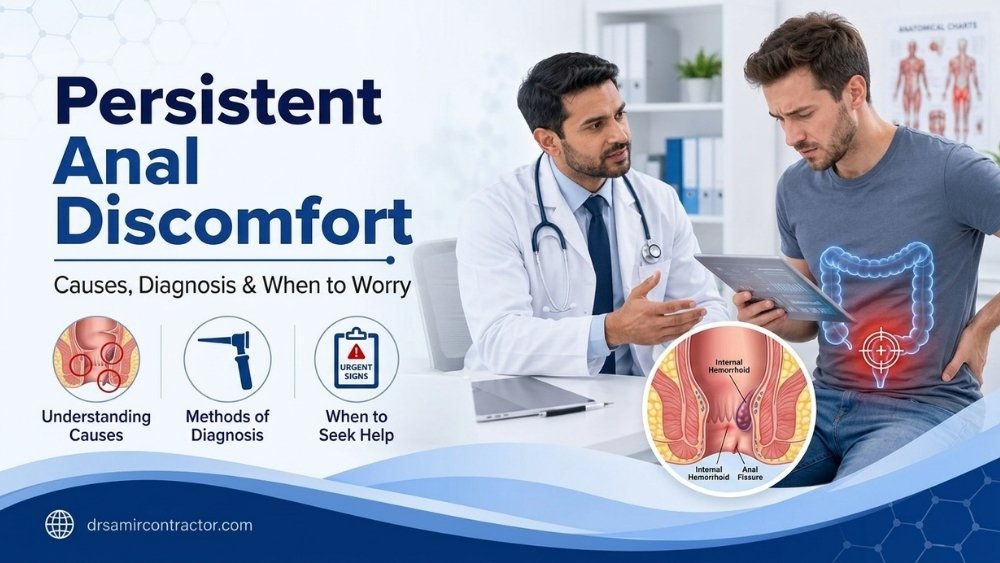
Not every anorectal problem announces itself with sharp pain or obvious bleeding. Many patients live with a vague, low-grade discomfort - a heaviness, a dull pressure, an aching that comes and goes - for weeks or months before they decide something needs attention. This page is written specifically for that experience. It explains what persistent anal discomfort means, why it is different from acute anal pain, what conditions cause it, how a proctologist investigates it, and what happens when it is left unchecked.
Quick Answers - Persistent Anal Discomfort at a Glance
What Does Persistent Anal Discomfort Actually Mean?
When a patient says "something just doesn't feel right down there," they are describing persistent anal discomfort - and it is one of the most under-reported anorectal complaints Dr Samir Contractor encounters in his Vadodara practice.
This is not the sharp, tearing pain of a fresh fissure. It is not the throbbing agony of a perianal abscess. Instead, it is a low-grade, hard-to-pinpoint sensation that patients struggle to describe. Common descriptions include:
- A vague heaviness or fullness in the anal area
- A dull aching pressure that worsens after sitting for long periods
- A background soreness that lingers after bowel movements but never reaches intense pain
- A nagging awareness of the anal region throughout the day - not painful enough to stop activities, but not ignorable either
- A sense of incomplete evacuation or persistent urge
Because it is vague, patients often dismiss it. Because it is not severe, they postpone the doctor visit. And because it is embarrassing, they self-medicate with over-the-counter creams for months before finally seeking help. By that time, what was once an easily treatable condition may have become more complex.
How Is This Different from Anal Pain?
This page specifically addresses the chronic, vague, low-grade end of the anorectal symptom spectrum. The companion page on anal pain covers acute, sharp or clearly identifiable pain - the kind with an obvious trigger and a recognisable character.
The distinction matters because patients with persistent discomfort often do not identify with the word "pain." They do not feel they qualify for a doctor visit because they cannot point to a single moment of intense suffering. They say things like:
- "It's not really pain - just something uncomfortable."
- "I've had this feeling for months but it never gets bad enough to worry about."
- "It comes and goes. Some days I barely notice it."
These are the patients who benefit most from early evaluation, because their symptoms - though mild - almost always point to a diagnosable, treatable condition.
Causes of Persistent Anal Discomfort
The following conditions are responsible for the majority of cases where ongoing low-grade discomfort is the dominant complaint.
1. Chronic Anal Fissure
An acute fissure that has not healed within 6-8 weeks becomes
chronic. The sharp pain of the initial tear gives
way to a persistent dull soreness and tightness around the anus, especially after bowel
movements. A sentinel
skin tag and fibrotic edges develop. Patients may notice mild bleeding on and off, but the
dominant complaint
becomes the constant background discomfort rather than acute cutting pain.
Read
more on Anal Fissure
2. Internal Haemorrhoids (Grade I-II)
Small to moderate internal piles that do not prolapse
significantly can cause a persistent sense of fullness,
mild aching and a dragging sensation in the anal canal. Because they do not produce dramatic
bleeding or visible
lumps in early stages, patients often live with this vague discomfort for months, attributing it
to diet or
stress. The discomfort tends to worsen after straining, prolonged sitting or spicy meals.
Read
more on Haemorrhoids (Piles)
3. Low-Grade Perianal Fistula or Abscess
Not every fistula or abscess presents with dramatic swelling and
fever. A low-grade, smouldering
intersphincteric abscess or a fistula with partial drainage can produce a persistent, mild
aching deep in the
anorectal area. Patients may notice occasional dampness or a faint discharge but nothing
alarming enough to
prompt an urgent visit. Left unchecked, these can progress to complex fistula tracts.
Read
more on Anal Fistula
4. Levator Ani Syndrome
This functional condition causes a chronic dull ache or pressure sensation high in the rectum, often described as "sitting on a ball" or a deep anorectal heaviness. Symptoms are worse with sitting and tend to improve with standing or walking. Episodes can last 20 minutes to several hours. Examination findings are minimal - the key finding is tenderness when the levator muscle is palpated on digital rectal examination. Pelvic floor physiotherapy and biofeedback are the primary treatments.
5. Proctalgia Fugax
Sudden, brief episodes of cramping rectal pain - lasting seconds to minutes - that occur unpredictably, often at night. Between episodes the patient feels well. While each episode is intense, the overall pattern creates a background of anxiety and ongoing awareness of the anorectal area. Patients often describe the cumulative effect as persistent discomfort, even though individual episodes are short-lived.
6. Early or Partial Rectal Prolapse
Internal rectal prolapse (intussusception) - where the rectal wall folds inward without protruding externally - causes a persistent sense of pressure, incomplete evacuation and rectal fullness. Patients feel like something is sitting in the rectum that they cannot pass. This condition is frequently missed because external examination appears normal; diagnosis requires specific clinical assessment or defecography.
7. Functional Anorectal Pain (Unspecified)
When all structural causes have been ruled out, some patients meet criteria for functional anorectal pain - chronic or recurrent discomfort in the anorectal region without an identifiable organic cause. This is a diagnosis of exclusion, made only after thorough investigation. It is related to pelvic floor muscle tension, central sensitisation or psychosomatic factors. Treatment involves pelvic floor rehabilitation, behavioural therapy and sometimes low-dose tricyclic medication.
Persistent Discomfort - Cause Comparison Table
| Condition | Character of Discomfort | Key Clue |
|---|---|---|
| Chronic fissure | Dull soreness, tightness after stool | Sentinel tag + mild bleeding |
| Internal piles (I-II) | Fullness, dragging, mild aching | Worse after straining or spicy food |
| Low-grade fistula | Deep aching, intermittent dampness | Small external opening + discharge |
| Levator ani syndrome | Deep rectal pressure, "sitting on a ball" | Worse sitting, better standing/walking |
| Proctalgia fugax | Brief intense cramps, ongoing anxiety | Self-limiting episodes, often nocturnal |
| Internal prolapse | Fullness, incomplete evacuation | Normal external exam; needs defecography |
| Functional anorectal pain | Variable dull ache, no pattern | Diagnosis of exclusion after workup |
When to Worry - Persistent Discomfort That Needs Urgent Attention
Most persistent discomfort stems from treatable, benign conditions. However, certain features signal that something more concerning may be happening and warrant prompt evaluation.
Red Flags - See a Proctologist Promptly If You Notice:
- Gradual worsening - discomfort that was once occasional is now daily and intensifying
- New bleeding - any rectal bleeding alongside persistent discomfort, especially dark blood or blood mixed with stool
- Unintentional weight loss - losing weight without dietary changes alongside anorectal symptoms
- Change in bowel habits - new-onset constipation, diarrhoea or alternating pattern lasting more than 4 weeks
- Discharge with odour - persistent dampness, pus or foul-smelling discharge from the anal area
- Palpable lump - a new or growing lump near the anus that does not resolve
- Family history of colorectal cancer - any persistent anorectal symptom in someone with a first-degree relative with colorectal cancer deserves formal evaluation
- Fever or night sweats - even low-grade fever alongside anal discomfort may indicate a smouldering abscess
Reassuring Signs - Likely Manageable at Home Initially
- Mild discomfort that follows a bout of hard stools and improves with dietary correction within a few days
- Brief, infrequent episodes (once a month or less) of rectal cramping that resolve completely in minutes
- Discomfort limited to prolonged sitting that goes away with movement and does not recur at rest
- No bleeding, no discharge, no lump, no weight loss, no bowel habit changes
Even reassuring presentations warrant a specialist visit if symptoms persist beyond 2-3 weeks or start to worsen.
How Is Persistent Anal Discomfort Diagnosed?
The challenge with persistent discomfort is that examination may appear grossly normal. A structured approach is essential.
1. Detailed Symptom History
Duration, character (heaviness vs. aching vs. pressure), relationship to bowel movements, effect of posture (sitting vs. standing), associated features (bleeding, discharge, lump) and previous treatments attempted - all of these narrow the differential before the physical examination begins.
2. Visual Inspection
The perianal area is inspected for sentinel skin tags (chronic fissure marker), external fistula openings, skin changes, prolapse on straining and haemorrhoidal tissue. In many persistent discomfort cases, external findings are subtle or absent.
3. Digital Rectal Examination (DRE)
A careful DRE assesses sphincter tone, identifies internal lumps or induration, checks for levator muscle tenderness (key for levator ani syndrome) and palpates for intersphincteric collections. This step alone can distinguish muscular from structural causes in many patients.
4. Proctoscopy / Anoscopy
Direct visualisation of the anal canal reveals internal haemorrhoids, chronic fissure features, low rectal pathology and mucosal changes that external examination cannot detect.
5. Advanced Investigations (When Indicated)
- MRI pelvis - gold standard for identifying hidden fistula tracts, deep intersphincteric abscesses and internal prolapse
- Endoanal ultrasound - evaluates sphincter integrity and detects small collections not palpable on DRE
- Defecography / MR defecography - essential for diagnosing internal rectal prolapse and obstructed defecation syndromes
- Colonoscopy - indicated if there are red-flag symptoms or age-appropriate screening is due
- Anorectal manometry - measures sphincter pressures and rectal sensation; useful in functional anorectal pain and levator syndrome
Treatment of Persistent Anal Discomfort
Treatment is guided entirely by the underlying diagnosis. Because multiple conditions can coexist, a specialist evaluation is needed before starting targeted therapy.
Conservative / Medical Approaches
- Dietary optimisation - high-fibre diet (25-35 g/day), 2-3 litres of water daily, avoiding excessive spice and processed food. This addresses the constipation component underlying many causes.
- Sitz baths - warm water soaks for 10-15 minutes, 2-3 times daily. Relaxes the anal sphincter, improves circulation and provides symptomatic relief across multiple conditions.
- Topical therapy - diltiazem 2% cream for chronic fissure; lignocaine gel for temporary symptom control. Generic "piles cream" is rarely the correct choice without a diagnosis.
- Pelvic floor physiotherapy - targeted exercises and biofeedback for levator ani syndrome and functional anorectal pain. Teaches the pelvic floor muscles to relax instead of remaining in chronic contraction.
- Behavioural modifications - avoiding prolonged toilet sitting, taking regular standing breaks during desk work, correct defecation posture (knees above hips).
Surgical / Procedural Options
- Lateral internal sphincterotomy (LIS) - for chronic fissure unresponsive to 6-8 weeks of medical therapy.
- Rubber band ligation - office-based procedure for Grade I-II internal haemorrhoids causing persistent discomfort.
- Haemorrhoidopexy / haemorrhoidectomy - for larger or recurrent haemorrhoids.
- Fistulotomy / LIFT / advancement flap - for confirmed fistula tracts. The choice of technique depends on tract complexity and sphincter involvement.
- Stapled transanal rectal resection (STARR) - for confirmed internal rectal prolapse causing obstructed defecation.
- Biofeedback programme - structured retraining for levator ani syndrome and functional anorectal pain, often achieving significant improvement over 6-12 sessions.
What Happens If Persistent Anal Discomfort Is Ignored?
The "it's mild, so it must be fine" mindset is the single biggest reason patients with treatable conditions end up needing more extensive interventions. Here is the typical progression Dr Samir Contractor sees when discomfort is left unchecked:
- Chronic fissure deepens: Fibrosis sets in, sphincter spasm becomes fixed, and what could have been managed with cream and diet now requires surgical sphincterotomy.
- Internal piles progress: Grade I-II haemorrhoids that could have been rubber-banded in the clinic advance to Grade III-IV, requiring formal surgery under anaesthesia.
- Low-grade fistula branches: A simple intersphincteric fistula left untreated for years can develop secondary tracts, horseshoe extensions or suprasphincteric involvement - transforming a straightforward repair into a multi-stage procedure.
- Levator syndrome becomes entrenched: Chronic pelvic floor tension that is not addressed early leads to central pain sensitisation, making the condition harder to treat with each passing month.
- Internal prolapse worsens: Partial intussusception can progress to full-thickness external rectal prolapse requiring major reconstructive surgery.
- Rare but serious causes are missed: The small percentage of patients whose discomfort is caused by a rectal tumour or anal canal carcinoma lose valuable time when evaluation is delayed.
The pattern is consistent: early evaluation means simpler treatment, faster recovery and better outcomes. Delayed evaluation means more complex surgery, longer recovery and higher recurrence risk.
India Relevance - Years of Self-Treatment Before a Correct Diagnosis
In Dr Samir Contractor's practice at Sterling Hospital, a specific pattern recurs among patients presenting with persistent anorectal discomfort:
- Prolonged self-medication: Patients use OTC haemorrhoid creams, ayurvedic "piles powders" or home-remedy pastes for 6 months to 2+ years before seeking specialist evaluation. These products may provide brief symptomatic relief but never address the underlying cause.
- Wrong diagnosis assumed: Many patients - and even some general practitioners - attribute every anorectal symptom to "piles." A chronic fissure, a smouldering fistula or levator syndrome is treated with piles cream for months, achieving nothing.
- Missed chronic fistula: A low-grade fistula that produces only mild discomfort and occasional dampness is one of the most commonly missed conditions in Indian primary care. By the time these patients reach a proctologist, the tract has become complex, with secondary openings and branching that demands more extensive surgery.
- Cultural reluctance: Anorectal symptoms carry significant stigma in Indian society. Patients - particularly women - endure months of discomfort rather than discuss the area with a doctor. This reluctance directly worsens clinical outcomes.
- Fear of surgery replacing facts: The outdated belief that anorectal surgery means weeks of painful bed rest prevents timely referral. Modern techniques - stapled procedures, laser-assisted surgery, minimally invasive fistula repair - offer recovery measured in days, not weeks.
Consult Dr Samir Contractor in Vadodara
If you have been living with a vague sense of discomfort, heaviness or pressure in the anal area for weeks or months - and you cannot quite pinpoint what is wrong - a focused 20-minute consultation can identify the cause and start the right treatment.
Race Course Road, Vadodara
Gujarat, India
8,000+ successful surgeries
MS, FMAS, FIAGES
Common Questions in Gujarati & Hinglish
Yes. Persistent mild discomfort often signals a condition like chronic fissure, internal piles or low-grade fistula that will not resolve on its own. Early evaluation means simpler treatment.
A sense of heaviness or fullness is commonly caused by internal haemorrhoids, early rectal prolapse or pelvic floor muscle tension. A proctologist can identify the exact cause with a brief examination.
If piles cream is not working, your problem may not be piles at all. It could be a chronic fissure, fistula or muscular issue. Stop self-treating and consult a specialist for correct diagnosis.
Persistent dampness or discharge can indicate a low-grade fistula. It may not feel urgent, but it needs evaluation because untreated fistulas become more complex over time.
A sense of incomplete evacuation is typical of internal rectal prolapse, internal haemorrhoids or obstructed defecation. Specific tests like defecography can confirm the cause.
Not necessarily. Sitting-related pressure may be caused by haemorrhoids or levator muscle tension, both of which often respond to conservative treatment. A specialist visit clarifies what is needed.
Something Not Right? Get It Checked.
Persistent discomfort that you cannot quite describe is still worth investigating. A focused 20-minute consultation with Dr Samir Contractor can identify the cause and outline a clear treatment path.