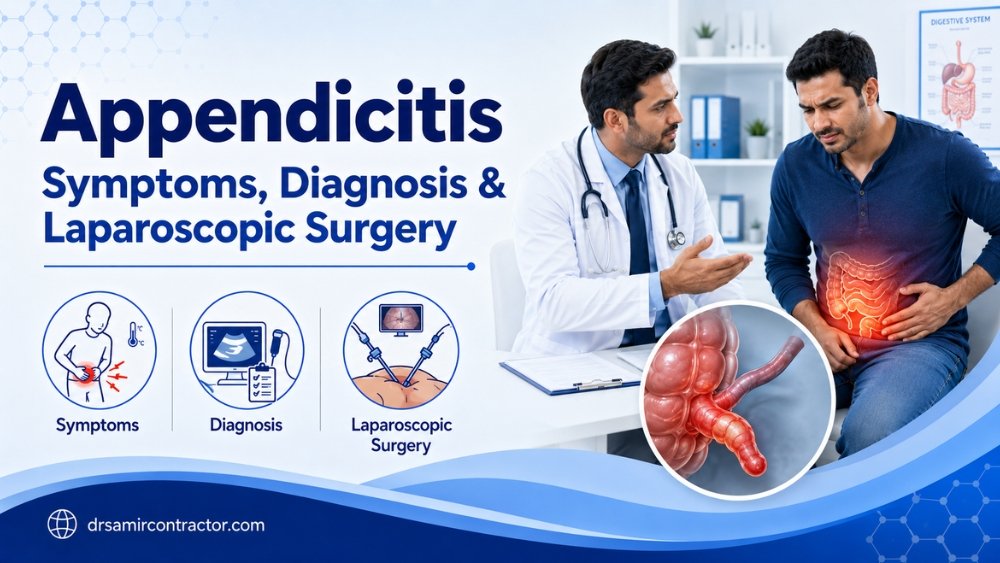
Appendicitis is inflammation and infection of the appendix - the most common abdominal surgical emergency in India and worldwide. It primarily affects young adults and children. Classic presentation: pain starting at the navel and shifting to the right lower abdomen, accompanied by loss of appetite, nausea, and fever. Treatment is laparoscopic appendectomy - safe, minimally invasive, and with rapid recovery.
Quick Answers
Appendicitis is one of the most common conditions requiring emergency surgery in India. The appendix - a vestigial structure with no clear function in adults - becomes obstructed, inflamed, and infected, producing a recognisable clinical syndrome. When diagnosed and treated promptly, outcomes are excellent. Delayed treatment risks perforation, peritonitis, and serious complications.
What Is the Appendix and Why Does It Get Inflamed?
The Appendix - Anatomy and Obstruction
The appendix is a 5–10 cm finger-shaped tube attached to the cecum (start of the large intestine) in the right lower abdomen. In most people, it hangs downward (retrocolic) or points toward the pelvis. Appendicitis begins when the appendix lumen is blocked - most commonly by a fecalith (hardened ball of faeces), lymphoid tissue hyperplasia (particularly in children, often after a viral infection), or rarely a tumour or foreign body. Once blocked, bacteria multiply in the stagnant appendix contents, causing increasing pressure, ischaemia of the wall, and ultimately bacterial invasion and infection.
Symptoms of Appendicitis: The Timeline
Causes and Risk Factors
- Fecalith - hardened faecal material obstructing the appendix lumen; the most common cause in adults
- Lymphoid hyperplasia - swelling of lymphoid tissue in the appendix wall from viral infection (e.g., common cold, gastroenteritis); most common cause in children and young adults
- Mucus plug - thick secretions blocking the appendix
- Appendicular tumour - rare; appendicular carcinoid or adenocarcinoma can obstruct the lumen
- Foreign body - very rare; seeds, small objects
Risk factors: Male sex (slightly higher risk), age 10–30 years (peak incidence), family history, diet low in fibre (leads to harder faeces and fecalith formation).
Seek emergency care if appendicitis symptoms are followed by:
- Sudden brief improvement of pain (appendix has just ruptured) then spreading pain
- Pain spreading from right lower to the whole abdomen
- Abdomen becoming rigid
- High fever (>39°C), rigors
- Signs of septic shock - low blood pressure, rapid heart rate, confusion
Diagnosis
Clinical assessment
History and examination are the starting point. Alvarado score calculated (see When Abdominal Pain May Be Appendicitis page). Rebound tenderness, Rovsing's sign (right lower pain on pressing left lower abdomen), and psoas sign (pain on right hip extension) are specific for appendicitis.
Blood tests
WBC elevated (>10,000) with neutrophilia in >70% of appendicitis cases. CRP elevated. Normal WBC does not exclude appendicitis - particularly early in the disease.
CT scan
The most accurate investigation - sensitivity >95%. Identifies appendix diameter (>6mm = abnormal), periappendiceal fat stranding, free fluid, and complications. Performed when Alvarado score is 5–8 or clinical diagnosis is uncertain.
Ultrasound
First-line in children and pregnant women to avoid radiation. Sensitivity 70–80% - lower than CT. A normal ultrasound does not exclude appendicitis in a clinically suspicious case.
Treatment - Laparoscopic Appendectomy
Laparoscopic appendectomy is the gold standard treatment for appendicitis. It is safe, effective, and provides rapid recovery.
The procedure
- 3 small incisions: one 10–12mm (navel area), two 5mm (right lower and central lower abdomen)
- Carbon dioxide gas inflates the abdomen to create working space
- Camera and instruments inserted through the incisions
- Appendix base divided with a staple or loop ligatures; appendix removed in an endobag
- General anaesthesia; 30–60 minutes
- Same-day or next-day discharge for uncomplicated disease
Advantages of laparoscopic over open appendectomy
- Smaller scars (nearly invisible at 6 months)
- Less post-operative pain
- Faster return to normal activity (1 week vs 2–3 weeks)
- Lower wound infection rate
- Diagnostic advantage - entire abdomen and pelvis inspected for alternative diagnoses
Antibiotic treatment for appendicitis
Some studies show antibiotics alone can treat uncomplicated appendicitis in the short term - however, 30–40% recur within 5 years, requiring surgery at a potentially more complex stage. The risk of missing an appendiceal tumour (carcinoid) without surgery is also relevant. Laparoscopic appendectomy remains the standard recommendation in India for most patients.
Recovery After Laparoscopic Appendectomy
- Day 1: Liquids in the morning after surgery; discharge same evening or next morning
- Days 1–3: Mild incision site discomfort; oral analgesics; light walking encouraged
- Week 1: Light activity; avoid heavy lifting; normal soft diet
- Week 2: Return to desk work, school; increasing activity
- Week 2–4: Return to physical work, exercise, and sports
- Scars: Three small scars that fade to near-invisible within 6–12 months
Appendicitis in India
- Appendicitis is among the most common emergency surgical conditions in India, with a very high volume of cases managed at every major surgical centre
- Delayed presentation - many patients take analgesics for 24–48 hours at home before presenting to hospital - leads to a higher proportion of perforated appendicitis in India compared to centres with earlier presentation
- Children in India tend to present with more advanced disease than adults - the progression from onset to perforation is faster in children (24–36 hours)
- Laparoscopic appendectomy is now widely available across major cities in Gujarat including Vadodara - outcomes at experienced centres are excellent
- Negative appendectomy rate (operating and finding a normal appendix) has reduced significantly with CT availability - but a "negative" appendectomy in a highly suspicious case is always preferable to allowing perforation
Seek Care in Vadodara
Suspected appendicitis - same-day CT evaluation and laparoscopic appendectomy at Sterling Hospital, Vadodara. Dr Samir Contractor's team available 24 hours for emergency surgical care.
Frequently Asked Questions
Desi Patient Questions
Nahi - long-term koi dietary restriction nathi. 1st week ma light food khaao - soft foods. 2nd week thi normal Gujarati diet resume kari shakay cho. Appendix nathi hoti to digestion, immunity, ya health par koi long-term effect nathi.
3 small scars: ek 10-12mm (navel area), biji banne 5mm (lower abdomen). 6-12 months ma nearly invisible thay chhe. Open surgery ma ek 5-7cm scar padé chhe. Laparoscopic definitely better cosmetically ane faster recovery.
Ha - early appendicitis ma fever absent hoi shake chhe, particularly in first 6–12 hours. Normal temperature does not exclude appendicitis. As inflammation progresses, fever typically develops. Fever absence with classic pain migration and anorexia still warrants evaluation. CT scan does not depend on fever - it assesses appendix anatomy directly.
Think It Might Be Appendicitis? Don't Wait.
CT scan + same-day laparoscopic appendectomy if confirmed. Emergency evaluation available 24 hours at Sterling Hospital.