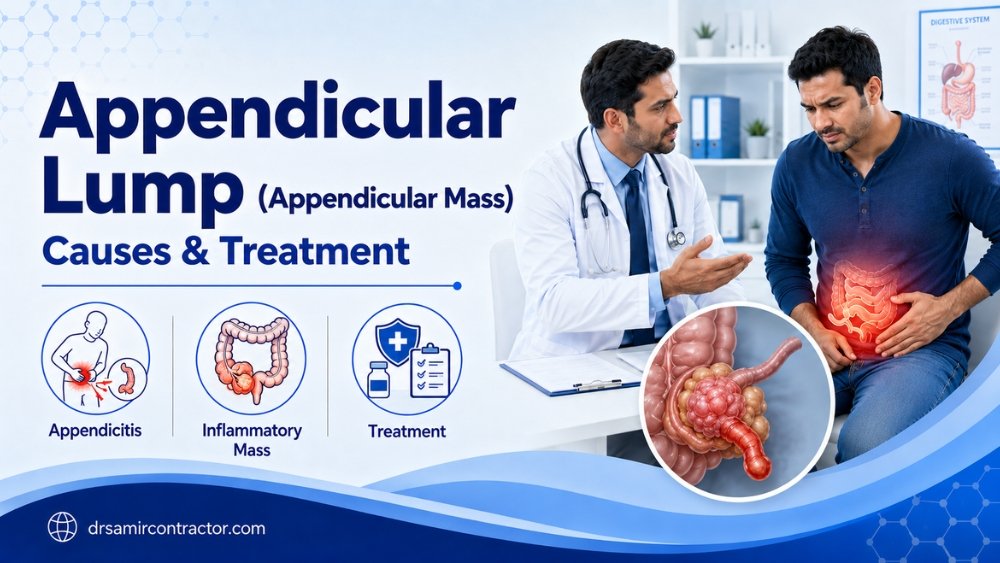
An appendicular lump (also called appendicular mass or phlegmon) forms when a perforated
appendix becomes walled off by the surrounding omentum and bowel, containing the infection
locally rather than allowing it to spread through the abdomen. It typically presents as a
palpable tender mass in the right lower abdomen, with pain present for 4–7 days or more.
Management is non-operative initially with IV antibiotics, followed by interval appendectomy 6–8
weeks later.
Quick Answers
What is an appendicular lump?
A mass in the right lower abdomen formed when a perforated
appendix is walled off by surrounding tissues. Also called appendicular phlegmon or mass.
Results from delayed appendicitis treatment.
Does it need immediate surgery?
Usually not - unlike free perforation with peritonitis. Managed
initially with IV antibiotics. Interval appendectomy planned 6–8 weeks later when
inflammation resolves.
What is interval appendectomy?
A planned laparoscopic appendectomy performed 6–8 weeks after
the appendicular mass has resolved with antibiotics. By this time, all inflammation is gone
and surgery is safe and straightforward.
Can it resolve without surgery?
The mass resolves with antibiotics. But the appendix remains -
and recurrence occurs in 30–40% without eventual appendectomy. Interval surgery is
recommended.
An appendicular lump is one of the most common late
presentations of appendicitis in India. When a patient has had right lower abdominal pain for
4–7 days without treatment, the appendix has usually already perforated - but the body's
defences have walled it off, forming a localised inflammatory mass rather than generalised
peritonitis. This "walling-off" is actually a protective response - it prevents the infection
from spreading throughout the abdomen.
The key management principle: do not rush to surgery when an
appendicular mass is present. Operating through dense inflammation is technically hazardous.
Allow the inflammation to resolve with antibiotics, then operate electively when conditions are
favourable.
How Does an Appendicular Lump Form?
In simple appendicitis, the appendix is inflamed but intact. If
untreated, the appendix perforates - usually within 24–72 hours. At this point, two outcomes are
possible:
- Free perforation with peritonitis - appendiceal contents spill freely into
the peritoneal cavity; generalised peritonitis develops rapidly; emergency surgery required
- Walled-off perforation (appendicular phlegmon) - the omentum (fat apron)
and adjacent loops of bowel migrate to the area and surround the perforated appendix;
infection is contained locally; an inflammatory mass forms over days; the body effectively
"quarantines" the infection
The appendicular phlegmon outcome is more likely when: the
perforation is slow (microabscess rather than free rupture), the patient has good immune
response, and there is adequate omentum present (less so in children, who have less developed
omentum - explaining why free peritonitis is more common in children with appendicitis).
Clinical Features
- Pain present for 4–7 days or more in the right lower abdomen
- Fever - may have been present for days
- Palpable tender mass in the right lower abdomen - firmness or fullness on examination
- Elevated WBC and CRP on blood tests
- CT scan confirms the mass: inflammatory thickening around a perforated appendix, often with
associated fat stranding and fluid collection
- Patient may have been managing with home analgesics for several days before presenting
Management - The Two-Stage Approach
Standard Management Pathway for Appendicular Lump
1
Stage 1 - Non-operative management (hospital
admission)
IV antibiotics (broad-spectrum, covering
gram-negative and anaerobic organisms). IV fluids. Nil by mouth initially. Regular
monitoring of temperature, WBC, and CRP. CT scan to confirm diagnosis and assess
extent of phlegmon.
2
If large abscess is present - CT-guided
drainage
A radiologist places a small drain into the
abscess under CT guidance, allowing the pus to drain and reducing the infection burden
more rapidly. This is performed in addition to antibiotics, not instead of
surgery.
3
Response assessment
Most patients show clinical improvement within
48–72 hours - fever settles, pain reduces, WBC falls. Diet gradually reintroduced.
Discharged when clinically well (typically 3–7 days).
4
Stage 2 - Interval appendectomy (6–8 weeks
later)
Laparoscopic appendectomy performed electively
when all inflammation has fully resolved. By this time, surgery is technically
identical to elective appendectomy - safe, fast, and with minimal complications.
Prevents the 30–40% recurrence within 5 years seen without surgery.
When to proceed with immediate surgery despite a mass
Immediate surgery is needed if: the mass shows signs of
spreading peritonitis (not localised); the patient deteriorates on antibiotics; or if a large
abscess cannot be drained percutaneously and the patient is not improving. In these situations,
laparoscopic surgery is attempted first, with conversion to open if the anatomy is too dense for
safe laparoscopic dissection.
Frequently Asked Questions
Operating through dense inflammatory tissue is dangerous. The omentum and bowel loops that
wall off the appendicular phlegmon are tightly adherent to the surrounding structures -
trying to dissect through this mass risks injuring adjacent bowel (causing an inadvertent
enterotomy), the right ureter, and blood vessels. The rates of conversion to open surgery,
bowel injury, and complications are significantly higher in immediate surgery for
appendicular mass than for elective interval appendectomy. Allowing 6–8 weeks for
inflammation to resolve completely is the safer, evidence-based approach.
Yes - recurrent appendicitis occurs in 30–40% of patients who have a first episode of
appendicular mass managed non-operatively without subsequent interval appendectomy. The
appendix, even after the mass has resolved, remains a potential site for further
obstruction and inflammation. This is the primary reason interval appendectomy is
recommended. Without it, the patient may present again months or years later with another
episode of appendicitis or mass formation.
An appendicular mass should raise awareness of appendiceal neoplasm (tumour) as a possible
cause of the obstrucing the appendix. Appendiceal carcinoid tumours and adenocarcinomas
can produce appendicitis and occasionally mass formation. During interval appendectomy,
the specimen is sent for histopathological examination to identify any underlying tumour.
An appendicular mass that does not resolve with antibiotics, or that recurs, should
increase suspicion for an underlying appendiceal or cecal neoplasm - a colonoscopy may be
recommended.
Desi Patient Questions
Doctor kahe chhe appendicular mass chhe -
operation havi nathi karvanu, 6 weeks pachhi karvashe - shu correct chhe?
Ha - bilkul correct chhe. Dense inflammation ma surgery karvathi
bowel injury ane complications vadhé chhe. Antibiotics thi mass resolve thay - 6-8 weeks
pachhi inflammation fully gone thay. Pachi laparoscopic surgery simple ane safe hoy chhe. This
is the evidence-based approach.
Appendicular Lump in India
- Appendicular lump is more common in India than in Western countries - primarily because
patients delay presentation for 4–7 days, by which time the appendix has often perforated
and a mass has formed
- Delayed presentation is driven by home analgesic use, misdiagnosis as "acidity" or "food
poisoning," and financial barriers to immediate hospital evaluation
- The two-stage approach (antibiotics + interval appendectomy) is now widely adopted at
experienced centres in India including Vadodara - outcomes are very good with proper
management
Seek Care in Vadodara
Right lower abdominal pain for 4–7 days with a palpable
mass - consult Dr Samir Contractor at Sterling Hospital, Vadodara for CT evaluation, IV
antibiotics management, and interval appendectomy planning.
Think It Might Be Appendicitis? Don't Wait.
CT scan + same-day laparoscopic appendectomy if confirmed.
Emergency evaluation available 24 hours at Sterling Hospital.
Article Reviewed by: Dr. Samir Contractor, Senior
Consultant Laparoscopic, Anorectal & Bariatric Surgeon,
MS, FRCS(UK), FMAS, FACS(USA), PN Certified exercise and
Nutrition Coach (Canada)
Clinical expertise: Anorectal surgery,
advanced laparoscopy, bariatric & metabolic surgery.
Medically Supervised Weight loss program
Experience: 25+ years of Clinical
experience.
Last medically reviewed: April 2026
Editorial policy: Content on
drsamircontractor.com is written and reviewed by a
practising surgeon. Each page is updated whenever clinical
practice guidelines change.
Medical Disclaimer: This page is for educational purposes only and does not
replace a face-to-face consultation with a qualified medical professional. The information
provided is based on general clinical principles and may not apply to every individual case. Do
not self-diagnose or self-treat based on this content. Dr.
Samir Contractor and Sterling Hospital, Vadodara, are not responsible for decisions made based
solely on this information.