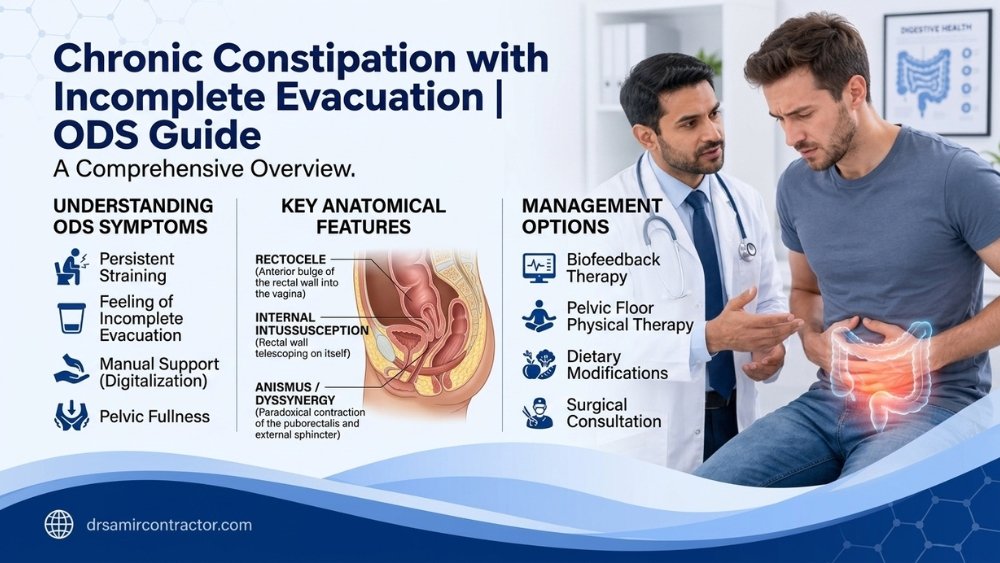
Chronic constipation combined with persistent incomplete evacuation - feeling that stool remains after defecation, excessive straining, and sometimes needing manual assistance - is the hallmark cluster of obstructed defecation syndrome (ODS). This cluster requires specialist anorectal evaluation including manometry and defecography. It does not fully respond to dietary changes and laxatives alone.
✦ Quick Answers
? Chronic Constipation + Incomplete Evacuation = ODS Until Investigated
When a patient describes: "I strain a lot, I only partially empty, I often feel like I still need to go right after finishing, and sometimes I need to press around my bottom to help" - this is obstructed defecation syndrome until anorectal manometry and imaging prove otherwise. This specific cluster does not respond to fibre and laxatives alone - it needs targeted investigation and treatment.
Classic ODS Presentation
- Chronic constipation with prolonged straining at each attempt
- Persistent feeling of incomplete evacuation after defecation
- Sensation of rectal or anal blockage - "something is in the way"
- Multiple trips to toilet for one bowel movement
- Pressing around the perineum or manually assisting evacuation
- Years of symptoms, typically in women (often after childbirth)
- Laxatives partially help but never fully resolve the problem
Causes of ODS
- Paradoxical puborectalis contraction - the puborectalis muscle, which normally relaxes during defecation, instead contracts and narrows the anorectal angle. The most common functional cause. Very treatable with biofeedback.
- Rectocele - forward bulging of the rectum into the posterior vaginal wall. Stool preferentially fills the rectocele pocket rather than the anal canal. Surgical repair when large and symptomatic.
- Rectal intussusception - internal telescoping of the rectal wall. Diagnosed on defecography. May respond to biofeedback or require surgery.
- Enterocele - small bowel loops prolapse into the rectovaginal space. Obstructs defecation. Surgical repair.
- Rectal prolapse (internal) - full-thickness rectal fold intussusception. Laparoscopic mesh rectopexy.
Investigations
- Anorectal manometry: Identifies paradoxical puborectalis contraction, reduced sphincter relaxation, and impaired defecation reflex
- Defecography (dynamic proctography): X-ray or MRI imaging of the defecation process; identifies rectocele size, rectal intussusception, enterocele, and pelvic floor descent
- Colonoscopy: To exclude structural colorectal causes - done before or alongside manometry and defecography
Treatment
Functional ODS - Biofeedback physiotherapy
For paradoxical puborectalis contraction - biofeedback is the most effective treatment. A pelvic floor physiotherapist uses real-time visual or electromyographic feedback to teach the patient to correctly relax the puborectalis during defecation. Success rates of 60-80% for symptom improvement. Requires 4-6 sessions. No medications or surgery needed for this subtype.
Structural ODS - Surgery
- Rectocele repair: Transvaginal or transanal approaches to reinforce the rectovaginal wall
- STARR procedure (Stapled TransAnal Rectal Resection): Endorectal stapling to remove redundant rectal tissue causing internal intussusception
- Laparoscopic ventral mesh rectopexy: Secures the rectum with mesh to the sacrum; addresses prolapse, rectocele, and enterocele simultaneously; preferred for complex ODS
Desi Patient Questions
Aa ODS (obstructed defecation syndrome) nu classic presentation chhe. Laxatives transit thi help kare chhe - pun outlet problem fix nathi karta. Anorectal manometry + defecography zaruri chhe diagnosis mate. Functional ODS: biofeedback physiotherapy highly effective (60-80% improvement). Structural (rectocele): surgical repair available. Doctor pase jao - specific diagnosis = specific treatment.
Frequently Asked Questions
Related Pages
Chronic Constipation + Incomplete Evacuation? Get ODS Evaluated in Vadodara
Anorectal manometry, defecography, biofeedback therapy, and surgical repair - comprehensive ODS management at Sterling Hospital, Vadodara.
Medical Disclaimer: For patient education only. Not a replacement for medical consultation.