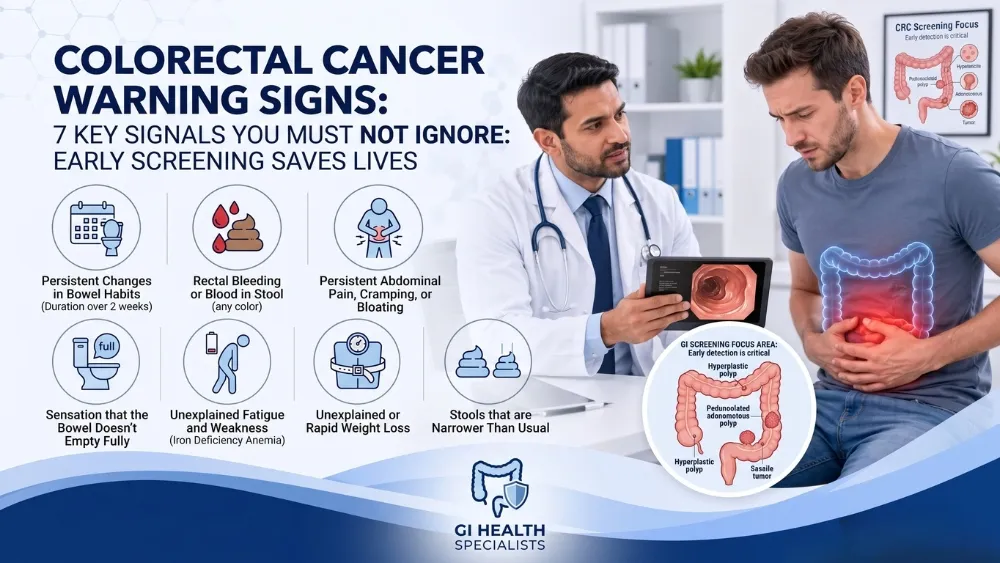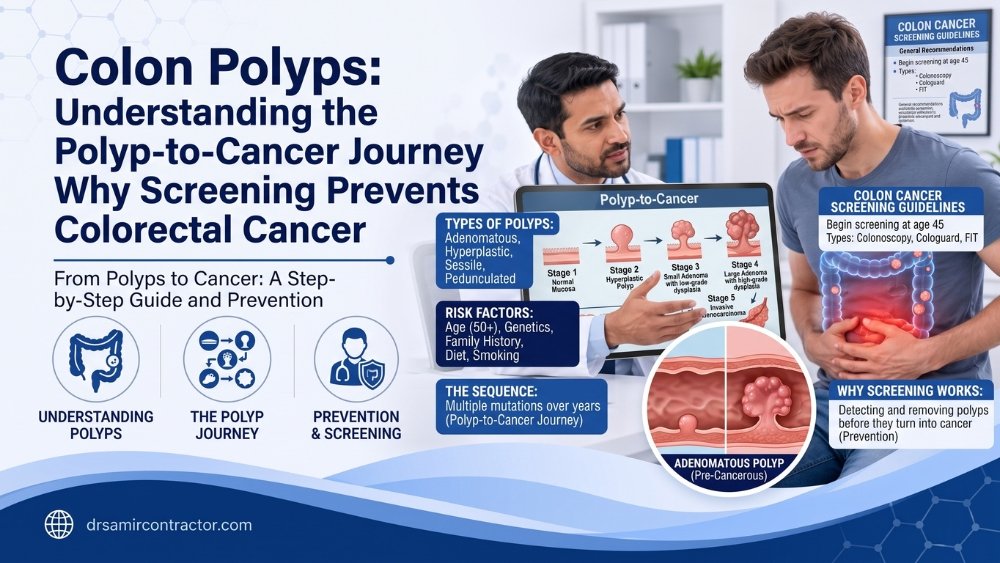
Nearly all colorectal cancers begin as small, non-cancerous growths called colon polyps. The journey from polyp to cancer takes 10 to 15 years - a window long enough for a single screening colonoscopy to find the polyp, remove it, and prevent cancer entirely. This page explains the types of colon polyps, which ones carry cancer risk, who should be screened and when, what happens during and after polyp removal, and the surveillance schedule that keeps you safe for life.
✦ Quick Answers
Colorectal cancer is the third most common cancer worldwide and one of the leading causes of cancer death in India. Yet it is also one of the most preventable cancers in existence - because it almost always begins as a colon polyp. Finding and removing that polyp before it transforms into cancer is the entire purpose of screening colonoscopy. This page focuses on that prevention story: the types of polyps, how they progress, who needs screening, and the surveillance roadmap after removal.
This page complements our guide on colorectal polyps and their symptoms, which covers how polyps present clinically - including bleeding. Here, the focus is the screening and prevention pathway: understanding polyp biology, identifying who is at risk, and building a surveillance plan that stops cancer before it starts.
What Are Colon Polyps and Why Do They Form
A colon polyp is a clump of cells that grows on the inner surface of the large intestine. The cells of the colonic lining normally divide, mature, and are shed in an orderly cycle. When the genetic controls over this cycle are disrupted - through inherited mutations, accumulated DNA damage, or environmental triggers - cells begin to multiply faster than they are shed. The excess cells form a small mound of tissue: a polyp.
Polyps can be flat (sessile), raised on a stalk (pedunculated), or slightly elevated above the surrounding mucosa. They range from 1 to 2 mm - barely visible - to over 30 mm. Size matters: larger polyps are more likely to harbour advanced changes, and polyps over 10 mm are considered clinically significant regardless of type.
The critical fact: Most polyps produce zero symptoms. They do not cause pain, bleeding, or bowel changes until they are large. This is precisely why screening colonoscopy is necessary - waiting for symptoms means waiting until the polyp is advanced or has already become cancer.
Types of Colon Polyps: Which Ones Matter
Not all polyps are equal. The type of polyp - determined by its microscopic appearance on pathology - dictates whether it carries cancer risk and how closely you need to be monitored after removal.
| Polyp type | Cancer risk | Frequency | Key characteristics |
|---|---|---|---|
| Adenomatous polyps (tubular adenoma) | Moderate - pre-cancerous | 60-70% of all neoplastic polyps | The classic pre-cancerous polyp. Risk increases with size: under 10 mm = low risk; 10-20 mm = moderate; over 20 mm = high. Most common in the left colon and rectum. |
| Tubulovillous adenoma | Higher than tubular | 10-25% of adenomas | Mixed architecture. Contains both tubular and villous (finger-like) elements. Villous component raises cancer risk. Often larger at detection. |
| Villous adenoma | Highest among adenomas | 5-10% of adenomas | Predominantly villous architecture. Often large, sessile, and located in the rectum. Up to 40% of villous adenomas over 20 mm contain cancer at removal. |
| Sessile serrated lesion (SSL) | Significant - pre-cancerous via serrated pathway | 15-25% of serrated polyps | Flat, often in the right colon, easy to miss during colonoscopy. Progresses to cancer through the serrated neoplasia pathway (different from adenoma-carcinoma sequence). Increasingly recognised as a major source of interval cancers. |
| Hyperplastic polyp | Negligible | Most common polyp type overall | Small (under 5 mm), usually in the rectum and sigmoid. No significant cancer risk. Requires no surveillance after removal unless very large or in the right colon. |
| Hamartomatous polyp | Low individually; syndromes carry higher risk | Rare | Occur in Peutz-Jeghers syndrome, juvenile polyposis, and Cowden syndrome. These hereditary syndromes carry significant lifetime cancer risk and require specialised surveillance protocols. |
| Inflammatory polyp (pseudopolyp) | Negligible (but underlying disease carries risk) | Seen in IBD patients | Result of chronic inflammation in ulcerative colitis or Crohn's disease. The polyp itself is not pre-cancerous, but the underlying inflammatory condition increases cancer risk independently. |
The Adenoma-Carcinoma Sequence: How a Polyp Becomes Cancer
The progression from normal colonic mucosa to invasive cancer follows a well-established molecular pathway. Understanding this sequence explains why screening works so well:
- Normal mucosa: The colonic lining functions normally. No visible abnormality exists.
- Aberrant crypt focus: Microscopic clusters of abnormal cells form in the colonic crypts. Not yet visible during colonoscopy. Driven by early mutations (typically in the APC gene).
- Small adenoma (under 10 mm): A visible polyp forms. Cell growth exceeds normal shedding. Low-grade dysplasia - cells look abnormal but not cancerous. This is the stage at which screening colonoscopy first detects the lesion.
- Advanced adenoma (10 mm or larger, villous features, or high-grade dysplasia): Additional mutations accumulate (KRAS, SMAD4, TP53). The polyp grows larger, and its cellular architecture becomes increasingly disordered. Cancer risk increases substantially.
- Carcinoma in situ: Malignant cells are present but confined to the mucosal layer. The cancer has not yet invaded deeper tissue. If removed at this stage, cure rates approach 100%.
- Invasive carcinoma: Cancer cells breach the muscularis mucosae and invade the submucosa, muscular wall, and eventually adjacent structures. Lymph node and distant metastasis become possible. Treatment now requires surgery, and potentially chemotherapy.
The 10-15 Year Window
The entire sequence - from the first aberrant cells to invasive cancer - takes an estimated 10 to 15 years in most cases. This is the central reason why screening colonoscopy is so powerful. A colonoscopy at age 45 that finds and removes a small adenoma has effectively prevented the cancer that would have developed by age 55 or 60. The polyp is removed. The sequence is interrupted. Cancer does not happen.
This is not early detection. It is actual prevention. Screening colonoscopy does not merely find cancer early - it prevents cancer from forming in the first place by removing its precursor.
A separate pathway - the serrated neoplasia pathway - operates for sessile serrated lesions. This pathway involves different molecular changes (BRAF mutation, CpG island methylation) and can progress more rapidly in some cases. Sessile serrated lesions are flat, often right-sided, and harder to detect during colonoscopy. Their recognition has led to improved detection techniques and adjusted surveillance intervals in modern practice.
Risk Factors for Colon Polyps
Some risk factors are beyond your control. Others are directly modifiable. Understanding both categories helps determine who needs screening and what can be done to reduce risk:
Non-Modifiable Risk Factors
- Age over 45: Polyp prevalence rises steeply after age 45. By age 60, roughly one in three people will have at least one polyp.
- Family history of polyps or colorectal cancer: A first-degree relative with colorectal cancer doubles your risk. The risk is higher still if the relative was diagnosed before age 60 or if multiple family members are affected.
- Hereditary polyposis syndromes: Familial adenomatous polyposis (FAP) causes hundreds to thousands of polyps, with near-certain cancer if untreated. Lynch syndrome (HNPCC) dramatically increases cancer risk without massive polyp burden.
- Personal history of polyps: If you have had adenomatous polyps before, you are at higher risk of developing new ones. Surveillance colonoscopy is mandatory.
- Inflammatory bowel disease: Long-standing ulcerative colitis or Crohn's colitis increases colorectal cancer risk independent of polyps.
Modifiable Risk Factors
- Diet low in fibre: A diet lacking vegetables, whole grains, and legumes increases polyp risk. The traditional Indian diet - rich in dal, sabzi, and whole wheat - is inherently protective when followed consistently.
- High intake of red and processed meat: Regular consumption of red meat (mutton, beef) and processed meat (sausages, bacon, salami) is consistently linked to increased polyp formation and colorectal cancer risk.
- Obesity: BMI over 30 increases colon polyp risk by 20 to 30%. Visceral (abdominal) fat is particularly associated with adenomatous polyps.
- Physical inactivity: A sedentary lifestyle is an independent risk factor. Regular moderate exercise (30 minutes daily, 5 days a week) reduces polyp incidence measurably.
- Smoking: Tobacco use increases both polyp formation and the progression rate from polyp to cancer. The risk correlates with duration and quantity.
- Heavy alcohol consumption: More than two alcoholic drinks per day increases adenoma risk. The effect is amplified when combined with smoking.
- Type 2 diabetes: Insulin resistance is associated with increased colorectal polyp and cancer risk. Poorly controlled diabetes amplifies this effect.
Who Needs Screening and When to Start
Screening means testing people who have no symptoms. If you already have symptoms - rectal bleeding, change in bowel habits, blood in stool, pencil-thin stools - you need a diagnostic colonoscopy, not screening. Screening is for the apparently healthy person who wants to ensure no silent polyps or cancer is developing.
| Risk category | When to begin screening | Recommended method | Screening interval |
|---|---|---|---|
| Average risk - no family history, no symptoms | Age 45 | Colonoscopy (gold standard) | Every 10 years if initial colonoscopy is completely normal |
| First-degree relative with CRC or advanced polyps (diagnosed age 60+) | Age 40 | Colonoscopy | Every 10 years if normal |
| First-degree relative with CRC or advanced polyps (diagnosed before age 60) | Age 40 or 10 years before relative's age at diagnosis - whichever is earlier | Colonoscopy | Every 5 years if normal |
| Two or more first-degree relatives with CRC at any age | Age 40 or 10 years before the youngest affected relative's diagnosis | Colonoscopy | Every 5 years |
| Known Lynch syndrome (HNPCC) | Age 20-25, or 2-5 years before youngest affected relative's diagnosis | Colonoscopy | Every 1-2 years |
| Known or suspected familial adenomatous polyposis (FAP) | Age 10-12 | Sigmoidoscopy or colonoscopy, with genetic testing | Annually until colectomy is indicated |
A note for Indian patients: India does not yet have a national population-based colorectal cancer screening programme. Screening depends entirely on individual awareness and physician recommendation. Given that nearly 20% of Indian colorectal cancers occur in patients under 40, age-based guidelines from Western countries may not fully protect Indian patients. If you have any family history or any persistent bowel symptoms, discuss screening with your surgeon regardless of your age.
Polyp Removal During Colonoscopy: What Actually Happens
One of the greatest advantages of colonoscopy over any other screening method is that it is both diagnostic and therapeutic in the same sitting. If a polyp is found, it is removed immediately - there is no need for a second procedure in most cases.
Techniques for Polyp Removal
- Cold snare polypectomy: A thin wire loop (snare) is placed around the polyp and closed, cutting through the stalk. No electrical current is used. The standard technique for polyps under 10 mm. Quick, safe, and highly effective.
- Hot snare polypectomy: Similar to cold snare but with electrocautery current applied through the wire, which cuts and cauterises simultaneously. Used for polyps 10 to 20 mm or those with a thick stalk.
- Endoscopic mucosal resection (EMR): Saline is injected beneath a large flat polyp to lift it off the muscle layer, then the raised polyp is removed with a snare. Used for sessile polyps larger than 20 mm. Requires advanced endoscopic skill.
- Piecemeal resection: Very large polyps (over 30 mm) may need to be removed in sections. Requires careful documentation and short-interval follow-up colonoscopy to ensure complete removal.
When Surgery Is Needed Instead
Endoscopic removal is not appropriate for every polyp. Laparoscopic surgical resection is required when:
- The polyp is too large or positioned in a location that makes endoscopic removal unsafe
- Biopsy reveals invasive cancer extending into the submucosa (T1 cancer with unfavourable features)
- The polyp cannot be lifted with submucosal injection (non-lifting sign - suggests deep invasion)
- Piecemeal removal was performed and recurrence is documented on follow-up
Every removed polyp is sent for histopathological examination. The pathology report - which specifies the polyp type, grade of dysplasia, completeness of removal, and presence or absence of cancer - is the single most important document for determining your surveillance schedule.
Due for Screening? Get Your Colonoscopy Done.
If you are over 45, have a family history of polyps or colorectal cancer, or have noticed any bowel changes - a screening colonoscopy at Sterling Hospital can find and remove polyps before they become a problem.
Surveillance Colonoscopy After Polyp Removal: The Follow-Up Schedule
Once polyps have been removed, the question becomes: when do you need the next colonoscopy? The answer depends entirely on what was found and removed. The following table reflects current guidelines (US Multi-Society Task Force, ESGE, BSG):
| Finding at index colonoscopy | Risk category | Recommended surveillance interval |
|---|---|---|
| 1-2 tubular adenomas, each under 10 mm, low-grade dysplasia | Low risk | 7-10 years |
| 3-4 tubular adenomas, each under 10 mm | Intermediate risk | 3-5 years |
| Any adenoma 10 mm or larger | High risk | 3 years |
| Any adenoma with villous histology | High risk | 3 years |
| Any adenoma with high-grade dysplasia | High risk | 3 years |
| 5-10 adenomas | High risk | 1-3 years |
| More than 10 adenomas | Very high risk - consider genetic testing | 1 year; genetic counselling recommended |
| Polyp removed piecemeal (large sessile lesion) | Requires completeness check | 6 months to confirm complete removal, then per pathology |
| Sessile serrated lesion under 10 mm, no dysplasia | Low risk | 5-10 years |
| Sessile serrated lesion 10 mm or larger, or with dysplasia | High risk | 3 years |
| Hyperplastic polyps only (rectosigmoid, under 10 mm) | Average risk | 10 years (same as average-risk screening) |
Red Flags: Symptoms That Demand Immediate Colonoscopy - Not Just Screening
Screening is for people without symptoms. If you have any of the following, you need a diagnostic colonoscopy - regardless of age or screening history:
- Rectal bleeding - blood on the stool, in the toilet, or on wiping
- Blood in stool - dark, maroon, or black tarry stools (melena)
- Change in bowel habits lasting more than 3 weeks
- Pencil-thin or ribbon-like stools
- Mucus in stool without a clear cause
- Iron-deficiency anaemia - especially in men or post-menopausal women
- Unexplained weight loss with any bowel symptom
- A palpable abdominal mass or progressive abdominal distension
- Family member newly diagnosed with colorectal cancer
- Positive faecal immunochemical test (FIT) or faecal occult blood test (FOBT)
These symptoms override any screening timeline. Do not wait for your next scheduled colonoscopy if new symptoms have appeared.
When Polyps Are Not a Major Concern
Not every polyp finding requires anxiety. The following scenarios are generally reassuring:
- One or two small hyperplastic polyps in the rectosigmoid - these carry negligible cancer risk and are treated as a normal finding
- A single small tubular adenoma under 10 mm with complete removal - this is the most common finding and carries very low risk with standard 7-10 year surveillance
- Inflammatory polyps (pseudopolyps) in a patient with known IBD - these are not pre-cancerous, though the IBD itself requires separate cancer surveillance
- A completely normal colonoscopy - no polyps found at all - in which case the next screening is in 10 years
Important: Even in low-risk scenarios, following the recommended surveillance interval is essential. The reassurance comes from the fact that your risk is low and your follow-up schedule is long - not from ignoring follow-up entirely.
Prevention: How Diet and Lifestyle Reduce Polyp Formation
While screening removes existing polyps, prevention reduces the formation of new ones. The evidence for lifestyle modification in polyp prevention is strong and consistent:
Protective Dietary Factors
- High dietary fibre: Whole wheat roti, dal, rajma, chana, vegetables, and fruits all provide the fibre that promotes healthy colonic mucosa. The traditional Indian thali - when it includes sabzi, dal, roti, and salad - is inherently protective.
- Calcium and dairy: Adequate calcium intake (through milk, curd, paneer, or supplements) is associated with reduced adenoma recurrence.
- Cruciferous vegetables: Broccoli, cauliflower (gobi), cabbage (patta gobi), and mustard greens contain sulforaphane, which has demonstrated anti-tumour properties in laboratory studies.
- Folate-rich foods: Green leafy vegetables (palak, methi), lentils, and chickpeas provide folate, which plays a role in DNA repair.
- Turmeric (haldi): Curcumin, the active compound in turmeric, has shown anti-inflammatory and anti-proliferative effects in colorectal tissue in research studies. Regular use of turmeric in cooking - as is traditional in Indian cuisine - is a reasonable dietary practice.
Dietary Risk Factors to Limit
- Red meat: Mutton, beef, and pork - particularly when cooked at high temperatures (tandoor, grilling, frying) - produce heterocyclic amines and polycyclic aromatic hydrocarbons that damage colonic DNA. Limit to 2-3 servings per week.
- Processed meat: Sausages, salami, bacon, and ready-to-eat packaged meats contain nitrates and preservatives linked to increased polyp risk. Minimise or avoid.
- Refined carbohydrates and sugar: Maida-based products (white bread, biscuits, cakes) and high sugar intake promote insulin resistance, which is associated with polyp formation.
- Alcohol: More than 2 drinks per day increases adenoma risk by approximately 30%. The effect is dose-dependent.
Lifestyle Factors
- Regular exercise: 30 minutes of moderate-intensity physical activity on most days reduces polyp risk by 15 to 20%. Walking, cycling, swimming, and yoga all count.
- Weight management: Maintaining BMI under 25 (or waist circumference under 90 cm for Indian men, under 80 cm for women) reduces risk substantially.
- Tobacco cessation: Stopping smoking reduces new polyp formation. The benefit increases with years of abstinence.
India Relevance: Colon Polyps, Rising Cancer Rates, and the Screening Gap
Colorectal cancer incidence in India is rising steadily - and the primary reason is that polyps are not being found and removed before they become cancer. The Indian context presents both unique risks and unique opportunities:
- No national screening programme: Unlike Australia, Japan, and the UK - which have population-based colorectal cancer screening that has reduced cancer mortality by 20 to 30% - India has no organised programme. Screening is entirely dependent on individual initiative and doctor recommendation.
- Young-onset colorectal cancer: Approximately 20% of Indian colorectal cancer patients are under 40. This means polyps are forming earlier in Indian populations, and age-45 screening guidelines may not be early enough for those with family history or risk factors.
- The dietary transition: Urban India is rapidly shifting from traditional high-fibre, plant-based diets (dal-roti-sabzi) to processed foods, fast food, refined flour (maida), and increased meat consumption. This transition is directly linked to rising polyp and cancer rates in Indian metros - Ahmedabad, Mumbai, Delhi, Bengaluru, and Vadodara included.
- Traditional diet as protection: The traditional Gujarati or South Indian vegetarian thali - with its dal, whole grains, vegetables, curd, and turmeric - contains precisely the elements that reduce polyp risk. Preserving these dietary traditions is a genuine cancer prevention strategy.
- "Piles" misattribution: Rectal bleeding from a polyp is routinely attributed to piles across India. Many patients receive topical haemorrhoid treatment for months or years without ever having a colonoscopy to check for polyps. This delay allows pre-cancerous polyps to progress unchecked.
- Colonoscopy availability is good in urban centres: Most tier-1 and tier-2 Indian cities - including Vadodara - have hospitals with modern colonoscopy facilities. The procedure is covered under Ayushman Bharat and several state insurance schemes. Cost should not be the barrier to screening.
- Awareness is the primary gap: The single greatest barrier to polyp prevention in India is not access or cost - it is awareness. Most Indians over 45 do not know that screening colonoscopy exists, that it prevents cancer, or that they should be asking for it.
Gujarati & Hinglish FAQs
Nahi. Badha polyps cancer nathi banta. Adenomatous polyp ane sessile serrated lesion ma cancer nu risk chhe - pan aa process 10-15 varsh le chhe. Jou colonoscopy thi polyp kaadhi nakho to cancer thay j nahi. Aa j screening nu mool faydo chhe.
Average risk hoy to 45 varsh ni umar thi. Jou family ma koine colorectal cancer ke advanced polyp thayo hoy to 40 varsh thi - ke emni diagnosis thi 10 varsh pahela, je pahelu hoy te. India ma young-onset cancer vadhu chhe, ettle family history hoy to doctor sathe vaat karo.
Aa pathology report par depend kare chhe. Nanu tubular adenoma hoy to 7-10 varsh. Motu adenoma (10 mm thi vadhu), villous type, ke high-grade dysplasia hoy to 3 varsh. 5 thi vadhu polyps hoy to 1 varsh. Report samjhva mate surgeon pase zarur jao.
Mota bhag na polyps colonoscopy darmiyan j nikli jay chhe - aa ne polypectomy kahevay. Koi chiro ke operation nathi padtu. Fakat bahuj mota polyp ke cancer malyu hoy tyare j laparoscopic surgery zaruri thay.
Normal taur par 10-15 saal lagta hai. Isliye screening colonoscopy itni important hai - polyp ko cancer banne se bahut pehle nikal sakte hain. Yeh early detection nahi, yeh cancer prevention hai.
Dr Samir Contractor, Sterling Hospital, Vadodara ma screening colonoscopy kare chhe. Polyp male to same sitting ma kaadhi nakhay chhe. 45 varsh thi upar hoy ke family history hoy to appointment lyo. WhatsApp karo: wa.me/919824593464
Frequently Asked Questions
Prevent Colorectal Cancer. Schedule Your Screening Colonoscopy.
If you are over 45, have a family history of polyps or colorectal cancer, or have had polyps removed in the past - your next step is clear. Book a screening colonoscopy with Dr Samir Contractor at Sterling Hospital, Vadodara.
Related Pages
Medical disclaimer: This page is for educational purposes only and does not constitute personal medical advice. Colon polyp management depends on individual pathology findings, personal and family history, and clinical context. Screening and surveillance intervals discussed here reflect current guideline recommendations but may be adjusted by your treating physician based on your specific situation. Always consult a qualified medical professional for decisions about your health. If you are experiencing symptoms, seek medical evaluation promptly - do not use this page as a substitute for clinical consultation.
© 2026 Dr Samir Contractor. All rights reserved.