Colorectal cancer is one of the most preventable cancers in medicine - yet it remains one of the deadliest when caught late. The difference between a 90% survival rate and a 15% survival rate is often nothing more than early detection through screening. This page covers the 7 cardinal warning signs of colorectal cancer, who is at risk, how screening works, and the critical polyp-to-cancer prevention pathway that makes timely colonoscopy genuinely life-saving. Whether you are here because of symptoms or because you want to understand when and how to get screened, this guide provides the clinical framework you need.
✦ Quick Answers
Why This Page Exists - Screening Over Symptom-Chasing
Most patients learn about colorectal cancer warning signs only after they notice something wrong - blood in the stool, unexplained weight loss, or a persistent change in bowel habits. By that point, the cancer has often progressed beyond its earliest, most treatable stage.
This page takes a different approach. While we cover all 7 cardinal warning signs in full clinical detail, the central message is this: the best time to detect colorectal cancer is before symptoms appear. Screening colonoscopy does not merely find cancer - it prevents cancer by removing the precancerous polyps that would otherwise transform over years into malignancy. Understanding when, how, and why to get screened is more valuable than knowing every symptom by heart.
If you have already noticed symptoms and are seeking answers, this page will help you understand what they may mean. If you are asymptomatic and wondering whether you need screening, this page will give you a clear, age-appropriate recommendation. Both paths lead to the same destination: a colonoscopy that provides definitive clarity.
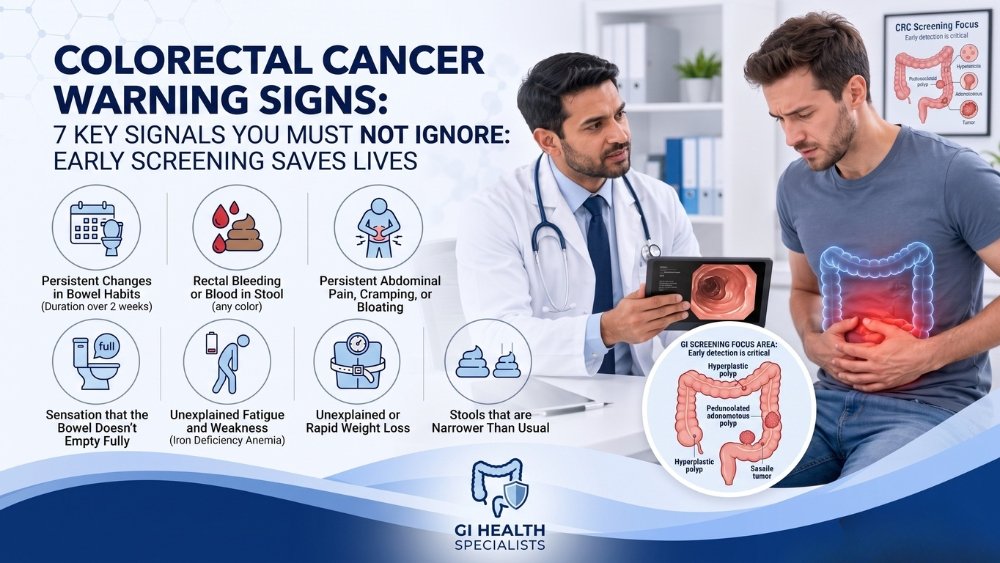
The 7 Cardinal Warning Signs of Colorectal Cancer
These are the signals that, individually or in combination, raise clinical suspicion for colorectal malignancy. None of them is exclusive to cancer - each has benign causes as well - but each requires investigation to rule out serious pathology.
1. Persistent Change in Bowel Habits
A change in bowel habits lasting more than 3 weeks - new constipation, new diarrhoea, or an alternating pattern - is the most common early sign of colon cancer. A growing tumour narrows the colonic lumen, causing stool to back up (constipation), then pass in a rush when liquid stool bypasses the obstruction (diarrhoea). The key distinction from benign causes: this change is progressive, meaning it worsens steadily rather than fluctuating with diet or stress.
2. Rectal Bleeding or Blood in Stool
Rectal bleeding - whether bright red blood on the tissue, dark blood mixed into the stool, or black tarry stool (melaena) - is the symptom that most frequently prompts medical attention. While haemorrhoids are the commonest cause of bright red rectal bleeding, any new rectal bleeding in a person over 40 requires colonoscopy to exclude a colonic or rectal tumour. Dark blood or blood mixed thoroughly into the stool is more concerning for a proximal (higher) source, including right-sided colon cancers.
3. Unexplained Iron-Deficiency Anaemia
Many colorectal cancers - particularly right-sided tumours - bleed slowly and imperceptibly. The patient notices no visible blood, but over months the chronic blood loss causes iron-deficiency anaemia: fatigue, pallor, breathlessness on exertion, and brittle nails. In any adult over 40 with newly diagnosed iron-deficiency anaemia and no other obvious explanation (such as heavy menstruation or a known bleeding disorder), colonoscopy is mandatory. Anaemia may be the only sign of colon cancer.
4. Unintentional Weight Loss
Unexplained weight loss of more than 5% of body weight within 6 months is always a red flag. In colorectal cancer, weight loss results from cancer cachexia (inflammatory cytokines that break down muscle and suppress appetite), reduced food intake due to partial obstruction, and the metabolic burden of the tumour itself. When weight loss co-occurs with any bowel symptom, the urgency of investigation increases substantially.
5. Persistent Abdominal Pain or Cramping
Abdominal discomfort is extremely common and usually benign. However, persistent or worsening pain in a fixed location - particularly in the lower abdomen - that does not respond to dietary changes, antacids, or antispasmodics warrants investigation. Advanced tumours can cause colicky pain from partial obstruction, or constant dull pain from local invasion. Acute severe pain with abdominal distension may indicate complete bowel obstruction, which is a surgical emergency.
6. Pencil-Thin or Ribbon-Like Stools
When stool calibre narrows persistently - stools become thinner than a finger or appear flattened like a ribbon - it suggests a physical narrowing of the colonic or rectal lumen. A tumour growing into the bowel wall is the most concerning cause. Functional causes (pelvic floor dysfunction, IBS) can occasionally produce thinner stools, but persistent narrowing in anyone over 40 is a direct indication for colonoscopy.
7. Persistent Feeling of Incomplete Evacuation
The sensation that the bowel has not fully emptied after defecation - also called tenesmus - is particularly associated with rectal cancers. A tumour in the rectum creates a constant sense of fullness and the urge to defecate even when the rectum is empty. This symptom is frequently dismissed as constipation or haemorrhoids, leading to dangerous delays in diagnosis. If tenesmus is new, persistent, and not explained by an obvious benign cause, a digital rectal examination and colonoscopy are needed.
When Investigation Is Non-Negotiable
Do not wait. Seek evaluation within days - not weeks - if you have:
- Any of the 7 warning signs above lasting more than 3 weeks without a clear benign explanation
- Two or more warning signs occurring together (e.g., bowel habit change plus weight loss, or bleeding plus anaemia)
- Age over 45 with any new, persistent bowel or rectal symptom
- Any age with a first-degree relative who had colorectal cancer or advanced polyps
- Iron-deficiency anaemia in any man, or in any post-menopausal woman, without another clear cause
- A palpable abdominal or rectal mass found on clinical examination
- Acute bowel obstruction symptoms: complete inability to pass stool or gas, severe colicky pain, abdominal distension, vomiting
In these situations, colonoscopy is not a recommendation - it is a clinical necessity. Delay can shift the stage of a potentially curable cancer into an incurable one.
Stage at Diagnosis Determines Survival
The relationship between cancer stage and survival in colorectal cancer is among the most dramatic in all of oncology. Understanding these numbers is not meant to cause fear - it is meant to motivate action.
| Stage | What It Means | 5-Year Survival | How It Is Typically Detected |
|---|---|---|---|
| Stage I | Cancer confined to the inner layers of the colon wall | Over 90% | Screening colonoscopy (often no symptoms) |
| Stage II | Cancer has grown through the colon wall but not reached lymph nodes | 70-85% | Screening or early symptom investigation |
| Stage III | Cancer has spread to regional lymph nodes | 50-70% | Symptomatic presentation (bleeding, bowel changes, pain) |
| Stage IV | Cancer has spread to distant organs (liver, lungs, peritoneum) | Under 15% | Advanced symptoms (weight loss, obstruction, liver enlargement) |
The table above illustrates a critical reality: the same cancer type has a 90%+ cure rate when found early and under a 15% survival rate when found late. The difference is not the biology of the cancer - it is the timing of detection. Screening is how you move from the bottom rows to the top.
The Polyp-to-Cancer Prevention Journey
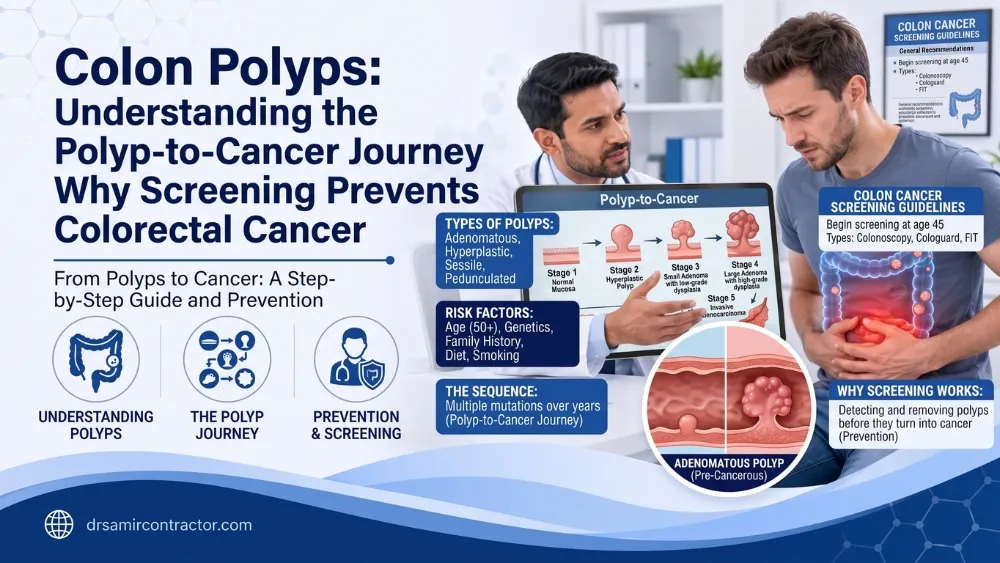
Unlike many cancers, colorectal cancer follows a well-characterised, slow progression that provides a wide window for intervention. The adenoma-carcinoma sequence is the foundation of colorectal cancer prevention:
- Normal mucosa - the healthy lining of the colon.
- Small adenomatous polyp - a benign growth, usually under 1 cm, that develops due to genetic mutations. Produces no symptoms. Detectable only by colonoscopy.
- Advanced adenoma - the polyp grows beyond 1 cm and develops features (villous histology, high-grade dysplasia) that indicate higher transformation risk. Still removable by colonoscopy.
- Carcinoma in situ - cancer cells are present but confined to the polyp. Complete polypectomy is curative.
- Invasive cancer - the cancer penetrates the bowel wall and may spread to lymph nodes and distant organs. Requires surgery and potentially chemotherapy.
The entire journey from step 2 to step 5 takes approximately 5 to 15 years. This is why screening colonoscopy at 10-year intervals (for average-risk individuals with normal findings) is effective: it catches and removes polyps long before they become dangerous. Removing a polyp takes minutes during colonoscopy. Treating the cancer that polyp would have become takes months of surgery, chemotherapy, and recovery - with no guarantee of cure.
Who Is at Risk? Key Risk Factors
Certain factors increase the likelihood of developing colon polyps and colorectal cancer. Understanding your personal risk profile determines when you should begin screening and how frequently.
- Age - Risk increases significantly after 45. Over 90% of colorectal cancers are diagnosed in people aged 45 and older. However, incidence in adults under 50 is rising in both India and globally.
- Family history - Having a first-degree relative (parent, sibling, child) with colorectal cancer or advanced polyps roughly doubles your risk. The risk is higher if the relative was diagnosed before age 60 or if multiple relatives are affected.
- Personal history of polyps - If you have previously had adenomatous polyps removed, you are at increased risk of developing new polyps. Regular surveillance colonoscopy is essential.
- Inflammatory bowel disease - Long-standing ulcerative colitis or Crohn's disease involving the colon increases colorectal cancer risk, particularly after 8 to 10 years of disease duration.
- Diet - High consumption of processed meat and red meat, combined with low fibre intake, is consistently associated with increased risk. A plant-rich, high-fibre diet is protective.
- Obesity - A body mass index above 30 is independently associated with increased colorectal cancer risk, particularly in men. Visceral (abdominal) fat is the most significant contributor.
- Smoking - Long-term smoking increases both the risk of developing colorectal polyps and the risk of those polyps transforming into cancer. The risk is dose-dependent.
- Alcohol - Regular consumption of more than two alcoholic drinks per day is associated with increased colorectal cancer risk.
- Physical inactivity - Sedentary behaviour is an independent risk factor. Regular moderate exercise (at least 30 minutes daily) reduces risk by approximately 20 to 25%.
- Hereditary syndromes - Lynch syndrome (hereditary non-polyposis colorectal cancer) and familial adenomatous polyposis (FAP) carry very high lifetime cancer risks and require specialised screening starting in early adulthood.
Screening Modalities Compared
Several screening tools are available. They differ in their sensitivity, invasiveness, cost, and - crucially - their ability to prevent cancer versus merely detect it.
| Screening Method | What It Does | Frequency | Strengths | Limitations |
|---|---|---|---|---|
| Colonoscopy | Direct visualisation of the entire colon; biopsy and polypectomy in the same sitting | Every 10 years (if normal); 3-5 years if polyps found | Gold standard; both diagnostic and preventive; highest sensitivity for polyps and cancer | Requires bowel preparation and sedation; small procedural risk (perforation approx. 1 in 1,000) |
| Faecal Immunochemical Test (FIT) | Detects hidden (occult) blood in stool using antibodies specific to human haemoglobin | Annually | Non-invasive, inexpensive, no preparation needed; can be done at home | Detects bleeding, not polyps directly; positive FIT still requires follow-up colonoscopy; misses non-bleeding polyps and early cancers |
| Flexible Sigmoidoscopy | Examines the rectum and left (distal) colon only - approximately the lower 60 cm | Every 5 years (often combined with annual FIT) | Less preparation than full colonoscopy; no sedation usually required | Misses right-sided lesions entirely; any abnormal finding still requires full colonoscopy |
| CT Colonography (Virtual Colonoscopy) | CT scan creates a 3D image of the colon after air insufflation | Every 5 years | Non-invasive; good detection of polyps over 10 mm | Still requires bowel preparation; radiation exposure; cannot remove polyps (requires follow-up colonoscopy if abnormal); lower sensitivity for flat or small polyps |
| Stool DNA Test (e.g., Cologuard) | Detects both blood and cancer-associated DNA mutations in stool | Every 3 years | Non-invasive; higher sensitivity than FIT alone for advanced neoplasia | Higher false-positive rate; not widely available in India; positive result requires colonoscopy; significantly more expensive than FIT |
The clinical bottom line: If you can undergo colonoscopy, it remains the most effective single screening tool because it is the only method that both detects and treats precancerous lesions in the same procedure. FIT is the best non-invasive alternative for those who cannot or will not undergo colonoscopy, but it must be repeated annually and any positive result must be followed up with colonoscopy. Using FIT as a permanent substitute for colonoscopy is acceptable only when colonoscopy is genuinely unavailable or contraindicated.
Age-Appropriate Screening Recommendations
Average Risk (No Family History, No Symptoms)
- Age 45: Begin screening with colonoscopy. If normal, repeat in 10 years.
- Alternative: Annual FIT starting at age 45, with colonoscopy if FIT is ever positive.
- Age 75-85: Screening decisions should be individualised based on overall health, life expectancy, and prior screening history.
- After age 85: Routine screening is generally not recommended.
Increased Risk (Family History)
- One first-degree relative with CRC or advanced adenoma diagnosed at age 60 or older: Begin screening at age 40 with colonoscopy. Repeat every 10 years if normal.
- One first-degree relative diagnosed before age 60, or two or more first-degree relatives at any age: Begin screening at age 40 or 10 years before the youngest relative's diagnosis, whichever is earlier. Repeat every 5 years.
High Risk (Hereditary Syndromes, IBD)
- Lynch syndrome: Colonoscopy every 1 to 2 years starting at age 20 to 25.
- Familial adenomatous polyposis (FAP): Annual sigmoidoscopy or colonoscopy starting at age 10 to 12.
- Inflammatory bowel disease (8+ years of colitis): Surveillance colonoscopy every 1 to 3 years depending on risk stratification.
When Symptoms Are Less Likely to Be Cancer
Not every bowel symptom indicates malignancy. The following patterns are generally lower risk - but a medical review is still recommended if they persist:
- Bright red blood only on wiping, associated with pain during defecation, in a person under 40 - most likely haemorrhoids
- Bowel habit changes that clearly follow a dietary shift, travel, medication change, or stressful period - and that resolve when the trigger is removed
- Brief episodes (under 2 weeks) of diarrhoea with a clear infectious trigger (gastroenteritis)
- Fluctuating symptoms that vary with meals and stress, improve on weekends or holidays, and do not wake you at night - suggestive of IBS
- No weight loss, no anaemia, no family history, and age under 40
Important: Even in lower-risk presentations, if any symptom persists beyond 4 weeks, investigation is still appropriate. Self-assigning yourself to the "safe" category without a medical assessment is not advisable.
Due for Screening? Have a Warning Sign?
Whether you are over 45 and need your first screening colonoscopy, or you have noticed a warning sign that needs investigation, Dr Samir Contractor offers comprehensive evaluation with same-visit colonoscopy capability at Sterling Hospital, Vadodara. Early action changes outcomes.
Colorectal Cancer Screening in India - An Urgent Gap
Colorectal cancer is the fourth most common cancer in Indian men and the third most common in Indian women, with incidence rising sharply over the past two decades. Despite this, India faces critical challenges in early detection:
- No national screening programme - Unlike the UK (NHS Bowel Cancer Screening), Australia, Japan, and South Korea, India does not have an organised population-level colorectal cancer screening programme. Detection relies entirely on individual awareness and proactive consultation.
- Late-stage diagnosis is the norm - Studies from major Indian cancer centres consistently report that over 60% of colorectal cancers are diagnosed at Stage III or IV. In countries with screening programmes, that figure is reversed, with the majority caught at Stage I or II.
- Younger age of onset - Indian data indicates a growing proportion of colorectal cancers occurring before age 50 - significantly earlier than in Western populations. This means age-based screening starting at 45 is particularly important in the Indian context, and symptom awareness should begin even younger.
- Dietary transition - The shift from traditional high-fibre diets (dal, roti, sabzi) toward processed foods, refined carbohydrates, and higher red meat consumption is contributing to rising polyp and cancer rates, especially in urban centres.
- Cultural reluctance to discuss bowel symptoms - Many patients attribute warning signs to "gas," "acidity," or "piles" and delay medical consultation for months. Bowel-related symptoms carry social stigma that prevents timely reporting.
- Screening is accessible but underutilised - Colonoscopy facilities exist in most Indian cities, including Vadodara. The barrier is not access but awareness. Patients who know they should be screened can access screening today - the challenge is reaching them with the right information.
The ICMR consensus: The Indian Council of Medical Research recommends opportunistic screening for individuals over 50, and from age 40 for those with a family history. Given the rising incidence in younger Indians, many Indian surgeons now advocate screening from age 45, aligned with American Cancer Society guidelines.
Gujarati & Hinglish ma Puchtachha Sawalo
Sauthi common early signs chhe: potty ni aadat ma persistent badlav (3 week thi vadhare), potty ma blood, ane samaj na aave aevi thakan ke anaemia. Pan important vaat ae chhe ke ghaNa early-stage cancers ma koi lakshano hota nathi - mate j screening colonoscopy jaruri chhe, lakshano na hoy to pan.
Average risk na loko mate 45 varsh thi. Jyo tamara family ma koi ne colon cancer ke polyps thayu hoy toh 40 varsh thi, athva je ummar ma tamara relative ne cancer thayu hoy tena thi 10 varsh pehla - je pan pehla aave te. India ma cancer nana ummar ma pan vadhti jaay chhe, mate awareness 40 thi rakhvu joiye.
FIT test saru chhe - non-invasive chhe, ghar ma thai shake chhe, ane dar varsh karvi joiye. Pan FIT positive aave toh colonoscopy to karavi j padse. Ane FIT polyps detect nathi karti - fakat blood detect kare chhe. Colonoscopy ek j procedure chhe je polyps shodhi ne turant kadhi pan nakhhe chhe. Jyo colonoscopy thai shake aevi sthiti ma hoy toh ae gold standard chhe.
Sadharan rite 5 thi 15 varsh. Aa long window chhe je screening ne etli effective banave chhe - polyp ne cancer thata pehla j colonoscopy thi kadhi naakhvama aave chhe. Ae mate j dhar 10 varsh ma ek colonoscopy pan cancer prevent kari shake chhe.
Ha, bilkul. 75% thi vadhare colorectal cancers aeva loko ne thay chhe jemne koi family history ke risk factor nathi - fakat ummar chhe. Lakshano na hova no matlab ae nathi ke polyps ke early cancer nathi. Screening ae j chhe je tamne jokhami vagar jaaNva na de.
Dr Samir Contractor, Sterling Hospital, Vadodara ma screening colonoscopy kare chhe. Same visit ma polyps mali aave toh turant kadhi naakhe chhe (polypectomy). Blood tests, FIT, ane staging investigation badhu ek j jagya ae coordinate thay chhe. English, Hindi, ane Gujarati ma consultation available chhe. Appointment mate phone ke WhatsApp karo.
Frequently Asked Questions
Screening Saves Lives - Act Before Symptoms Appear
If you are over 45 and have never been screened, or if you have noticed any warning sign described on this page, do not postpone. A single colonoscopy can detect and remove the polyps that would otherwise become cancer. Dr Samir Contractor and his team at Sterling Hospital, Vadodara are here to help - with expertise, clarity, and care.