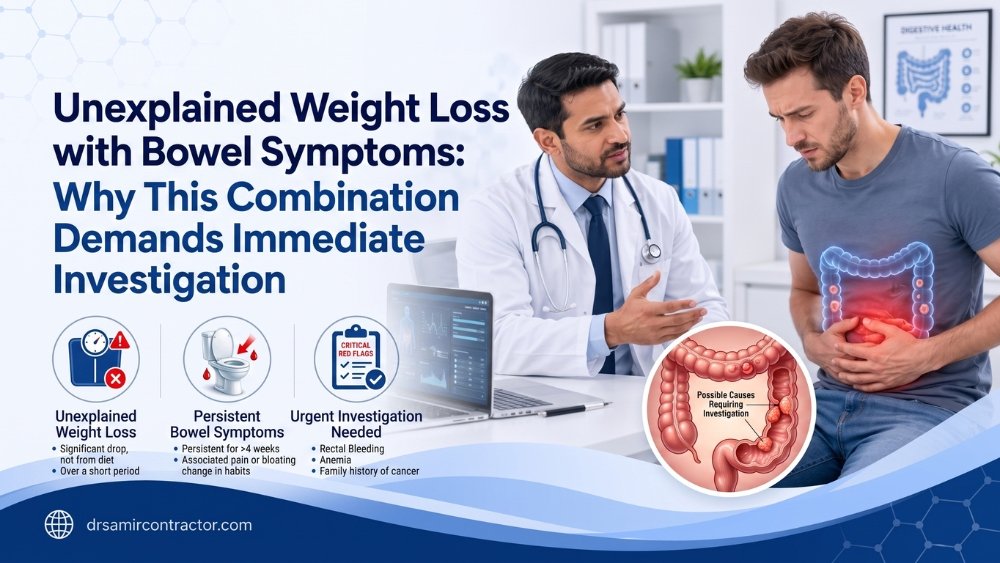
When your body is losing weight without explanation - and your bowel habits have changed - these two signals together represent one of the most urgent combinations in gastrointestinal medicine. Whether the bowel symptom is diarrhoea, constipation, blood in stool, or a change in stool shape, the addition of unintentional weight loss transforms it from a possible nuisance into a mandatory investigation. This page explains what the combination means, what conditions can cause it, and why you must not wait.
✦ Quick Answers
Weight loss on its own has many causes. Bowel symptoms on their own are extremely common. But when the two occur in the same person at the same time - and the weight loss has no clear explanation - the clinical significance is far greater than either symptom alone. This is a combination where watching and waiting is not appropriate. This is a combination where you book a colonoscopy.
This page is different from our guide on blood in stool with weight loss, which focuses specifically on bleeding as the bowel symptom. Here we address the broadest entry point: the patient who is losing weight and has noticed any change in bowel function - diarrhoea, constipation, stool shape change, mucus, blood, or alternating patterns. The differential diagnosis is wider, but the urgency is equally high.
What Makes This Combination So Alarming
Each symptom in isolation has a broad differential. Unintentional weight loss can result from metabolic disorders, psychological conditions, medications, and malignancy. Bowel symptoms affect millions of people and are most often functional (IBS) or dietary. But the overlap changes the probability picture dramatically:
- The bowel symptom points to a local process. Something is affecting the intestinal tract - whether it is a tumour narrowing the lumen, inflammation damaging the mucosa, or malabsorption impairing nutrient uptake.
- The weight loss points to a systemic consequence. The body is either failing to absorb calories, burning them at an abnormal rate (hyperthyroidism, cancer cachexia), or both. The gut and the metabolism are linked, and they are both malfunctioning.
- Together, they significantly raise the probability of serious organic disease. Published data shows that unexplained weight loss combined with a change in bowel habits has a positive predictive value for colorectal cancer that exceeds 10% in patients over 50 - meaning roughly 1 in 10 people with this combination will have cancer. No responsible clinician ignores these odds.
The Full Differential: What Can Cause Both Symptoms Together
Colorectal cancer is the diagnosis that must be excluded first, but it is not the only serious condition that produces this combination. A thorough evaluation considers the following:
| Condition | Bowel symptoms | Weight loss mechanism | Key distinguishing features |
|---|---|---|---|
| Colorectal cancer | Blood in stool, constipation, pencil-thin stools, alternating habit, tenesmus | Cancer cachexia (cytokine-driven muscle wasting), obstruction reducing intake | Age over 45, progressive worsening, iron-deficiency anaemia, family history |
| Coeliac disease | Chronic diarrhoea, bloating, steatorrhoea (pale fatty stool) | Malabsorption of calories, iron, folate, and fat-soluble vitamins | May present at any age; iron-deficiency anaemia, positive tTG antibodies; very underdiagnosed in India |
| Inflammatory bowel disease (Crohn's, ulcerative colitis) | Bloody diarrhoea, mucus, urgency, abdominal pain | Chronic inflammation, malabsorption, reduced appetite | Younger onset, relapsing-remitting course, extra-intestinal manifestations (joint pain, skin lesions) |
| Intestinal tuberculosis | Diarrhoea alternating with constipation, right lower abdominal pain | Chronic infection drives fever, night sweats, appetite loss | Common in India; mimics Crohn's and colorectal cancer on imaging; TB contact history |
| Hyperthyroidism | Frequent loose stools, increased bowel frequency | Accelerated basal metabolic rate burns calories faster than intake | Heat intolerance, tremor, palpitations, anxiety, goitre; TSH is low |
| Chronic parasitic or amoebic infection | Bloody diarrhoea, mucus, cramping | Chronic nutrient loss, inflammation, poor absorption | Travel or contaminated water exposure; stool microscopy positive |
| Small bowel malabsorption (tropical sprue, pancreatic insufficiency) | Bulky pale stools, diarrhoea, bloating | Fat and nutrient malabsorption | Common in Indian subcontinent (tropical sprue); chronic pancreatitis history for pancreatic cause |
| HIV-associated GI disease | Chronic diarrhoea, opportunistic infections cause mucosal damage | HIV wasting syndrome, chronic infection | Known HIV status, multiple infections, low CD4 count |
The critical point: Every condition in this table requires investigation that begins with blood tests and a colonoscopy. The treatment for each is completely different - surgery for cancer, a gluten-free diet for coeliac disease, anti-tubercular drugs for TB, immunosuppression for IBD, thyroid medication for hyperthyroidism. Getting the right diagnosis is not just important, it is everything. And the right diagnosis starts with a scope.
How the Body Loses Weight When the Gut Is Involved
Understanding the mechanisms helps explain why the combination is so significant. There are three principal pathways:
1. Cancer Cachexia
A colorectal tumour releases inflammatory cytokines - TNF-alpha, IL-6, IL-1 - that suppress appetite, increase the body's resting metabolic rate, and directly break down muscle protein. The result is progressive weight loss even when the patient tries to eat normally. As the tumour grows, partial bowel obstruction further reduces food intake by causing early fullness, nausea, and cramping after meals. Cancer cachexia is difficult to reverse once established, which is why early detection matters so profoundly.
2. Malabsorption
In coeliac disease, the immune system attacks the villi - the tiny finger-like projections lining the small intestine that absorb nutrients. Damaged villi cannot absorb iron, folate, calcium, fat, or calories efficiently. The patient eats a normal quantity but absorbs a fraction. The result: weight loss, diarrhoea, anaemia, and fatigue. A similar mechanism operates in tropical sprue (common in India), chronic pancreatitis (where digestive enzymes are insufficient), and extensive Crohn's disease affecting the small bowel.
3. Hypermetabolism
Hyperthyroidism increases the basal metabolic rate by 20-50%. The body burns through calories faster than the patient can consume them. The excess thyroid hormone also accelerates gut motility, causing frequent loose stools and increased bowel frequency. The combination of weight loss with loose stools is easily mistaken for a primary bowel problem, but the root cause is hormonal. A simple TSH blood test identifies it.
Why the Mechanism Matters for You
If you are losing weight and your bowels have changed, the underlying mechanism determines the treatment. Cancer requires surgery. Coeliac disease requires dietary change. Hyperthyroidism requires medication. Intestinal TB requires a 6-9 month antibiotic course. Identifying the right mechanism is impossible without proper testing. That is why investigation is non-negotiable.
Red Flags: When to Seek Urgent Evaluation - Do Not Wait
See a surgeon or gastroenterologist within days - not weeks - if you have unexplained weight loss along with any of the following:
- Blood in stool - bright red, dark red, or black tarry stool
- A change in bowel habits lasting more than 3 weeks - new constipation, new diarrhoea, or alternating pattern
- Pencil-thin or ribbon-like stools that are different from your usual pattern
- Progressive fatigue, pallor, or breathlessness (suggesting iron-deficiency anaemia)
- A palpable lump or swelling in the abdomen
- Feeling that the bowel never fully empties (tenesmus)
- Night sweats or unexplained fever alongside bowel symptoms
- Family history of colorectal cancer or polyps
- Age over 40 with new-onset bowel symptoms and weight loss
- Persistent abdominal pain or bloating that does not resolve with dietary changes
- Mucus in stool without a clear dietary or infectious cause
If you recognise two or more items from this list alongside unintentional weight loss, a colonoscopy is not a suggestion - it is a clinical necessity.
When It Is Less Likely to Be Serious
Not every instance of weight change with bowel disturbance indicates cancer. The following patterns are generally lower risk - but still warrant a medical review if persistent:
- Intentional weight loss through diet or exercise, with mild bowel changes related to increased fibre or dietary shift
- A brief episode (under 2 weeks) of diarrhoea with temporary appetite loss during an acute gastroenteritis - weight typically returns after recovery
- Medication side effects (metformin, antibiotics, iron supplements) causing bowel changes in someone whose weight loss has a known cause
- Stress-related appetite loss with functional bowel symptoms (IBS pattern) - but only after organic causes have been properly excluded
Important: Even in these lower-risk scenarios, if the weight loss exceeds 5% of body weight or persists beyond 4 weeks, investigation is still recommended. Do not self-diagnose the "safe" category.
Diagnosis: The Investigation Pathway
When a patient presents with unexplained weight loss and bowel symptoms, the evaluation follows a structured protocol. There are no shortcuts.
Step 1: Blood Tests
- Complete blood count (CBC): Checks haemoglobin and MCV. Low haemoglobin with low MCV suggests iron-deficiency anaemia from chronic blood loss or malabsorption.
- Iron studies: Serum ferritin, serum iron, TIBC - confirms iron deficiency and helps distinguish blood-loss anaemia from malabsorption.
- Thyroid function (TSH, free T4): Rules out hyperthyroidism as the cause of weight loss and loose stools.
- Coeliac antibodies (tTG-IgA): Screens for coeliac disease - underdiagnosed in India, especially in patients with chronic diarrhoea and weight loss.
- Inflammatory markers (CRP, ESR): Raised in cancer, IBD, TB, and chronic infections.
- Liver function, kidney function, albumin: Low albumin indicates chronic disease or advanced malignancy. Deranged liver tests may suggest metastatic disease.
- CEA (carcinoembryonic antigen): Tumour marker - useful as a baseline if colorectal cancer is found, not reliable for screening.
Step 2: Colonoscopy with Biopsy
The definitive investigation. A flexible scope examines the entire colon and rectum. Any suspicious lesion - mass, ulcer, stricture, polyp - is biopsied during the same procedure. The biopsy result is the gold standard: it tells us whether the lesion is malignant, pre-malignant, inflammatory, granulomatous (TB), or normal.
A colonoscopy takes 20-30 minutes, is performed under sedation, and is safe. The information it provides cannot be replicated by any blood test, CT scan, or stool analysis. It is the single most important step in this diagnostic pathway.
Step 3: Upper GI Endoscopy (When Indicated)
If colonoscopy is normal but weight loss persists, or if coeliac disease is suspected, an upper GI endoscopy with duodenal biopsies may be performed. This examines the oesophagus, stomach, and upper small intestine - identifying coeliac disease, gastric lesions, or other causes of malabsorption.
Step 4: Imaging (If Cancer or TB Is Suspected)
- CT scan of chest, abdomen, and pelvis: For staging if colonoscopy reveals a mass - identifies lymph node involvement, liver metastases, lung metastases.
- MRI pelvis: For rectal cancers - assesses depth of invasion and surgical planning.
- PET-CT: In selected cases where extent of spread is unclear.
Losing Weight with Bowel Symptoms? Do Not Wait.
This symptom combination requires investigation - not reassurance. Book a consultation with Dr Samir Contractor for a structured evaluation and same-week colonoscopy at Sterling Hospital, Vadodara.
Treatment Depends Entirely on the Diagnosis
The treatment path is radically different depending on what the investigation reveals. This is precisely why getting the right diagnosis matters so much:
| Diagnosis | Primary treatment | Prognosis when caught early |
|---|---|---|
| Colorectal cancer (Stage I-II) | Laparoscopic surgical resection; adjuvant chemotherapy if indicated | 5-year survival exceeds 80-90% - excellent when detected before spread |
| Colorectal cancer (Stage III-IV) | Surgery + chemotherapy (FOLFOX/CAPOX); targeted therapy for select Stage IV | Stage III: 50-70%. Stage IV: 10-20%. Every week of delay worsens the stage. |
| Coeliac disease | Strict lifelong gluten-free diet; iron and vitamin supplementation | Excellent - intestinal healing begins within weeks, weight recovers within months |
| Inflammatory bowel disease | Immunosuppressive and biologic therapy; surgery for complications | Good with long-term medical management; requires ongoing monitoring |
| Intestinal tuberculosis | Anti-tubercular therapy (ATT) for 6-9 months | Excellent with complete treatment adherence |
| Hyperthyroidism | Anti-thyroid medication (carbimazole/methimazole); radioactive iodine or surgery in select cases | Very good - weight normalises as thyroid function is controlled |
| Large polyps / advanced adenomas | Endoscopic removal (polypectomy); surgical resection if too large | Excellent - removal prevents progression to cancer |
The message: Most conditions on this list are treatable or curable - but only if diagnosed in time. Delay narrows the treatment options and worsens outcomes. This applies especially to colorectal cancer, where the survival difference between Stage I and Stage IV is the difference between a routine operation and a life-threatening disease.
What Happens If This Combination Is Ignored
In clinical practice, patients frequently delay. The reasons are human - embarrassment, fear of the diagnosis, assumption that it will resolve, or being told it is "nothing serious." But the consequences of delay are measurable:
- A Stage I colorectal cancer can progress to Stage III or IV within 12-18 months. What was curable with surgery alone now requires chemotherapy, radiation, and possibly a permanent stoma.
- Undiagnosed coeliac disease causes progressive nutritional deficiency. Severe iron deficiency, osteoporosis, and in rare cases, intestinal lymphoma can develop from untreated coeliac disease.
- Untreated hyperthyroidism leads to cardiac complications - atrial fibrillation, heart failure - in addition to continued weight loss and muscle wasting.
- Cancer cachexia becomes self-perpetuating. Once severe muscle wasting is established, the patient tolerates surgery and chemotherapy poorly. Nutritional recovery becomes extremely difficult.
- Anaemia worsens progressively. Patients may require blood transfusions. Severe anaemia at the time of surgery increases operative risk significantly.
- Bowel obstruction may occur. A growing tumour can block the colon, requiring emergency surgery - which carries much higher complication rates than a planned procedure.
India Relevance: Late Presentation of Colorectal Cancer and Screening Gaps
In India, more than 60% of colorectal cancers are diagnosed at Stage III or IV. This is not because the disease is inherently more aggressive here - it is because patients present late and symptoms are dismissed or misattributed. The specific challenges in the Indian context:
- The "piles and acidity" culture: Rectal bleeding is overwhelmingly attributed to piles, and bowel changes are attributed to "acidity" or dietary indiscretion. When a patient also reports weight loss, this should immediately trigger referral for colonoscopy. In many primary care settings, it does not.
- No national colorectal cancer screening programme: Unlike countries with organised screening (UK, Australia, Japan), India relies entirely on symptom-driven diagnosis. This means the burden falls on the patient and the primary care doctor to recognise warning combinations and act on them.
- Young-onset colorectal cancer is disproportionately high. Nearly 20% of Indian colorectal cancer patients are under 40 - a significantly higher proportion than in Western populations. Western age-based screening guidelines do not fully apply to Indian patients. Any young Indian with unexplained weight loss and bowel changes needs investigation regardless of age.
- Intestinal TB mimics cancer closely. India has the world's highest TB burden, and intestinal TB can present with weight loss, bowel changes, and a mass on CT scan that is indistinguishable from cancer without biopsy. This makes colonoscopy with biopsy even more critical - the treatment for TB (antibiotics) and cancer (surgery + chemotherapy) are completely different.
- Coeliac disease is significantly underdiagnosed. Studies suggest a prevalence of 0.5-1% in northern India, yet the majority of cases remain undetected. Patients are labelled with "IBS" or "chronic acidity" for years while malabsorption and nutritional deficiency progress silently.
- Dietary transition is increasing risk. The shift from traditional high-fibre Indian diets to processed food, refined carbohydrates, and high red meat consumption - combined with sedentary urban lifestyles - is driving a measurable increase in colorectal cancer incidence in Indian metros.
- Cost and access barriers are real but addressable. Colonoscopy is available at most district-level hospitals and tertiary centres across India. It is covered under Ayushman Bharat and several state government health schemes. Financial barriers, while real, should not prevent investigation of this symptom combination.
The message for Indian patients: If you are losing weight and your bowels have changed, do not accept a diagnosis of "IBS," "acidity," or "piles" without a colonoscopy. Insist on the test. The earlier a serious condition is found, the better the outcome - and most of the conditions that cause this combination are treatable.
Gujarati & Hinglish FAQs
Haa, aa combination cancer ni ek important nishani chhe. Pan coeliac disease, TB, ane thyroid problem pan kaaran hoy shake. Colonoscopy karavi mandatory chhe - jaldi karavo.
Aa combination ma blood test ane colonoscopy banne zaruri chhe. Thyroid test ane coeliac test pan karavo. Doctor pase turant jao - wait na karo.
Nahi. IBS thi vazan nathi ghattu. Jou vazan ghattu hoy to koi organic kaaran chhe - colonoscopy ane blood tests karavine confirm karo. IBS nu diagnosis tabaj valid chhe jyare serious karano exclude thaya hoy.
Dr Samir Contractor, Sterling Hospital, Vadodara ma colonoscopy ane biopsy ni facility chhe. Urgent cases ma same-week scheduling available chhe. WhatsApp karo: wa.me/919824593464
Ye combination serious ho sakta hai. Sirf acidity ya IBS samajh ke ignore mat karo. Blood test aur colonoscopy zaroor karwao. Jaldi pata chale to colon cancer bhi completely curable hai.
Na. Sedation ma thay chhe - 20-30 minute lagey chhe. Tayyari (pet saaf karvu) sabauthi mushkel part chhe, procedure comfortable chhe. Aa test thi cancer, TB, ane bija serious conditions identify thay chhe.
Frequently Asked Questions
Do Not Wait. Get Investigated Now.
Unexplained weight loss with bowel symptoms is not a combination to monitor at home. Book a consultation with Dr Samir Contractor at Sterling Hospital, Vadodara for a complete evaluation including blood tests, colonoscopy, and a clear diagnostic plan.
Related Pages
Medical Disclaimer: This content is for educational purposes and does not replace a face-to-face consultation with a qualified surgeon or gastroenterologist. Every patient's situation is unique - diagnosis and treatment must be individualised based on clinical evaluation. If you are experiencing unexplained weight loss with bowel symptoms, please consult a doctor promptly. Dr Samir Contractor and Sterling Hospital are not responsible for clinical decisions made solely based on this article. In an emergency, visit your nearest hospital immediately.
© 2026 Dr Samir Contractor. All rights reserved.