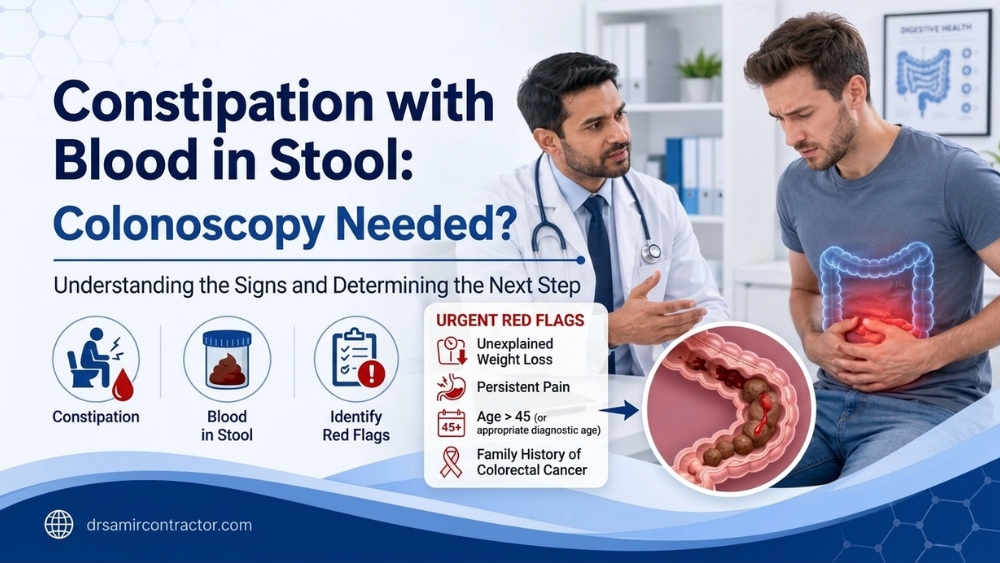
Constipation with blood in stool is a symptom combination that always requires proper evaluation. Most cases have a benign, treatable cause (hemorrhoids or anal fissure). But this same combination can be the early presentation of colorectal cancer or polyps. The decision to proceed to colonoscopy is based on the patient's age, the character of bleeding, and associated features - not on assuming a benign cause without examination.
✦ Quick Answers
When Colonoscopy Is Needed vs. Examination Alone
| Patient Profile | Recommended Action |
|---|---|
| Age under 40, bright red blood on toilet paper, sharp anal pain, hard stools, no weight loss | Clinical Examination - confirm fissure diagnosis; treat conservatively; colonoscopy if not improving |
| Age under 45, bright red blood after straining, prolapsing tissue, no pain, no weight loss | Clinical Examination + Proctoscopy - confirm hemorrhoids; treat; colonoscopy if any doubt |
| Age above 45 with any rectal bleeding | Colonoscopy Required - regardless of apparent benign cause; colorectal cancer screening threshold |
| Any age with blood mixed into (not just on surface of) stool | Colonoscopy Required - blood mixed into stool suggests higher colonic source |
| Weight loss accompanying bleeding | Urgent Colonoscopy - weight loss + bleeding = colorectal cancer until proven otherwise |
| Change in bowel habit (new constipation) + bleeding | Colonoscopy Required - change in bowel habit is a red flag for colorectal pathology |
| Family history of colorectal cancer + any bleeding | Colonoscopy Recommended - higher baseline risk justifies earlier screening |
| Symptoms not improving with 4-8 weeks of treatment for presumed benign cause | Colonoscopy Required - persistent symptoms despite treatment warrant evaluation |
Red Flags
Colonoscopy needed urgently when bleeding + constipation includes:
- Unintended weight loss
- Blood mixed into stool (not just on surface or paper)
- Dark red or maroon blood in stool
- Pencil-thin stools
- Patient above 45 years
- Family history of colorectal cancer
- Anaemia on blood tests
Treatment
For all patients - treat the constipation first
Increase dietary fibre (25-35g/day), water (2-3L/day), and regular activity. This is essential regardless of the bleeding cause - hard stools perpetuate hemorrhoids and fissures.
Hemorrhoids confirmed on examination
Rubber band ligation (outpatient, very effective for grade 2-3 hemorrhoids), sclerotherapy, or hemorrhoidectomy for large grade 3-4 hemorrhoids.
Anal fissure confirmed
Topical GTN/diltiazem ointment + stool softening. Botox or surgery for chronic fissures.
Polyps found on colonoscopy
Polypectomy at the same colonoscopy session. Follow-up colonoscopy surveillance schedule based on polyp type and number.
Cancer found on colonoscopy
CT staging, MDT team management, colorectal surgery with curative intent for early disease.
Desi Patient Questions
Jyaré age 45+ hoy, ya weight loss hoy, ya stool ma blood mixed hoy - ha, colonoscopy zaruri chhe. Hemorrhoids most likely chhe, but colorectal cancer same presentation aapé chhe early stage ma. Colonoscopy confirms benign cause ya identifies cancer early when it's curable. 20-40 min procedure, sedation sathe, comfortable chhe.
Frequently Asked Questions
Related Pages
Constipation + Blood in Stool? Don't Assume - Get Evaluated in Vadodara
Colonoscopy and anorectal evaluation at Sterling Hospital, Vadodara. Dr Samir Contractor provides accurate diagnosis and treatment.
Medical Disclaimer: For patient education only. Constipation with bleeding always needs evaluation.