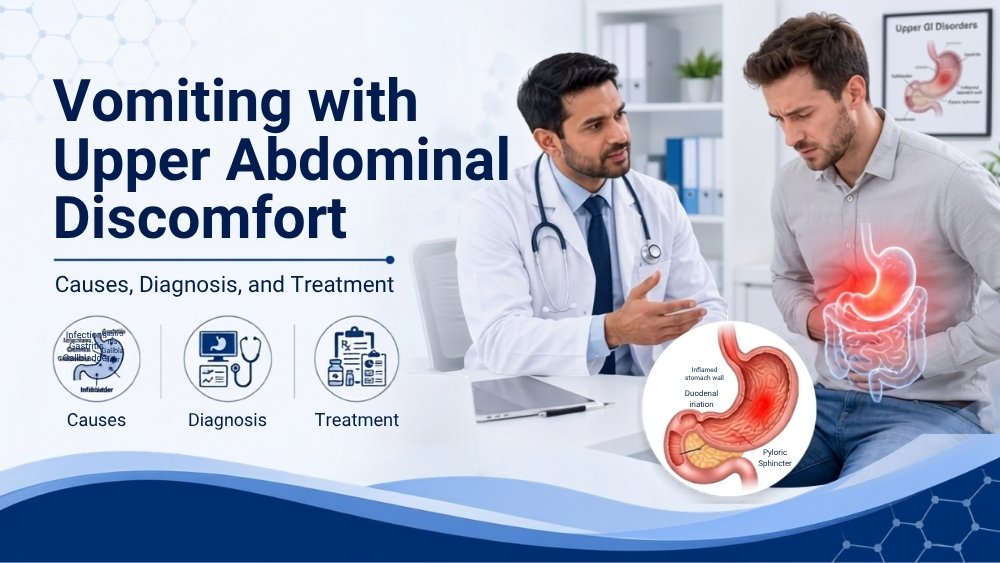
Vomiting combined with upper abdominal pain is a common and clinically important symptom cluster. It can arise from something as manageable as gastritis or food poisoning - or something as serious as acute pancreatitis or a perforated ulcer. The location of the pain, its character, the presence of fever, and what the vomit looks like are the key factors that separate urgent from non-urgent causes.
Quick Answers
Vomiting by itself has many causes. Upper abdominal pain by itself has many causes. When the two occur together, the combination narrows the diagnostic range significantly. The most useful diagnostic approach is pattern recognition - the specific location of the pain, its timing relative to meals, its character, and the features of the vomit together point strongly toward a specific cause.
This page helps patients understand which pattern their symptoms fit - and which require urgent attention versus a planned medical evaluation.
Pattern Recognition - Matching Symptoms to Likely Causes
| Pain Location | Character | Associated Features | Most Likely Cause | Urgency |
|---|---|---|---|---|
| Right upper abdomen | Colicky waves, after fatty food | Nausea, right shoulder radiation | Gallstones / biliary colic | See Doctor Soon |
| Right upper abdomen | Constant, severe, tender on pressure | Fever, nausea, vomiting | Acute cholecystitis | Urgent |
| Central upper (epigastric) | Boring, radiates to back, constant | Severe vomiting, history of alcohol or gallstones | Acute pancreatitis | Emergency |
| Central upper (epigastric) | Sudden severe, "knife-like" | Rigid abdomen, collapse | Perforated peptic ulcer | Emergency |
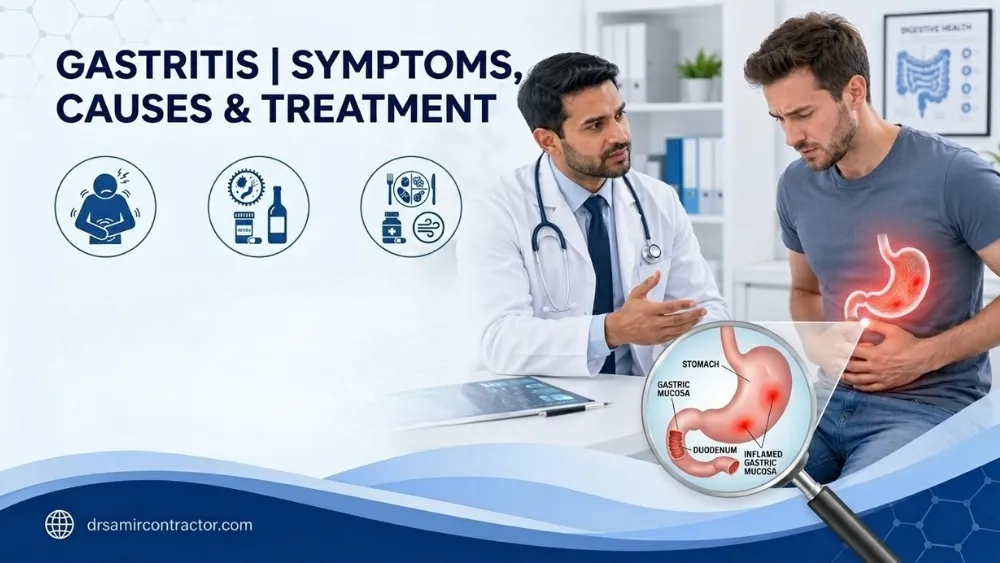
| Central upper (epigastric) | Burning, gnawing - linked to meals | Heartburn, nausea, partial relief with antacids | Gastritis / peptic ulcer / GERD | Planned Care |
| Diffuse upper abdomen | Cramping with nausea and diarrhoea | Recent outside food, others affected | Gastroenteritis / food poisoning | Usually Self-Limiting |
| Upper abdomen with jaundice | Colicky, severe, associated yellow discolouration | Fever, dark urine | Choledocholithiasis / cholangitis | Emergency |
The most important distinction in this cluster is between surgical emergencies (pancreatitis, perforated ulcer, cholecystitis, cholangitis) and non-surgical causes (gastritis, GERD, food poisoning). Fever with upper abdominal pain and vomiting always moves a case toward urgent evaluation.
Typical Presentations
Non-urgent presentations
- Gastritis / peptic ulcer: Burning upper central pain with nausea and vomiting, linked to meals or empty stomach, partially relieved by antacids. Not constant. Improves and recurs.
- GERD with vomiting: Heartburn with nausea and occasional vomiting after large or oily meals. Not severe. No fever. Responds to PPI therapy and dietary change.
- Food poisoning / gastroenteritis: Sudden onset after eating outside food, often with diarrhoea, others affected. Typically resolves within 24-72 hours with oral hydration.
Urgent presentations
- Biliary colic: Right upper severe pain with vomiting 30-60 min after fatty meal; pain may radiate to right shoulder; colicky (waves); resolves then recurs. See a doctor - surgery prevents future attacks.
- Acute cholecystitis: Constant right upper pain, tender to touch, fever, vomiting. Does not fully resolve. Requires hospitalisation and antibiotics - surgery needed.
- Acute pancreatitis: Severe constant central pain radiating to back, worse lying flat, better sitting forward; persistent vomiting that does not relieve pain. Requires emergency hospitalisation.
Red Flags and Emergency Features
Seek emergency care if vomiting with upper pain includes:
- Severe, constant pain that is not relieving and is worsening
- Pain radiating from upper abdomen to the back - pancreatitis pattern
- Fever alongside the pain and vomiting - infection (cholecystitis, cholangitis, appendicitis)
- Jaundice (yellow eyes or skin) with pain - biliary obstruction
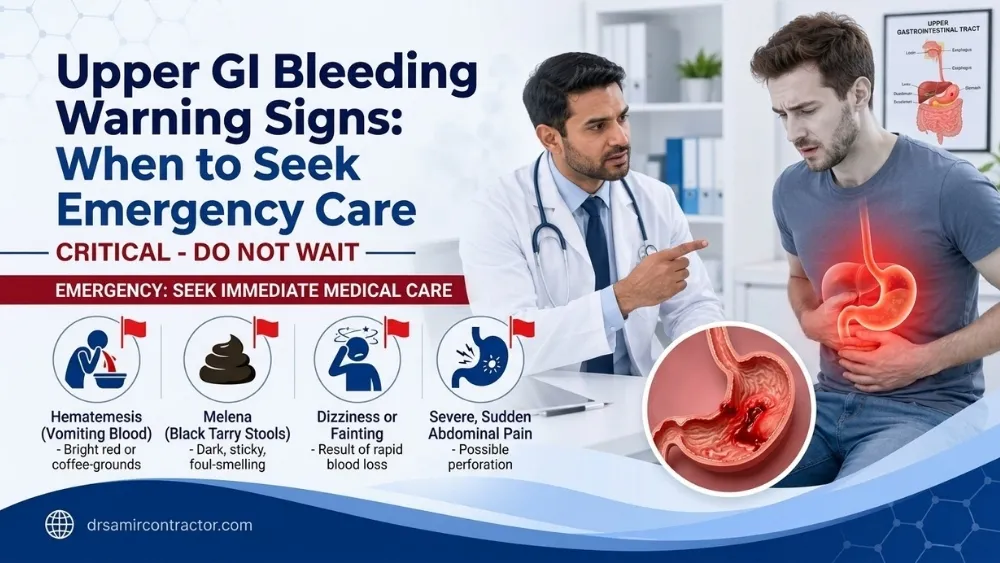
- Blood in vomit - bright red or coffee-ground appearance
- Rigid or board-like abdomen - peritonitis, perforated ulcer
- Severe dehydration - cannot keep any liquid down, no urine, extreme weakness
- Post-operative vomiting with pain after recent abdominal surgery
Go to emergency immediately if:
- Upper abdominal pain is sudden, severe, and constant (possible perforation or pancreatitis)
- Vomit is blood-stained or coffee-ground coloured
- Abdomen becomes rigid - do not push or press on it
- Jaundice appears with pain and vomiting
Tests That May Be Needed
Not every patient needs every test. Investigations depend on age, pain location, severity, fever, and associated features.
Blood tests (usually first)
Full blood count (infection), amylase and lipase (pancreatitis), liver function (biliary obstruction, hepatitis), kidney function (dehydration), blood glucose. These are drawn quickly in emergency settings and give rapid diagnostic information.
Ultrasound abdomen
Identifies gallstones, cholecystitis, liver pathology, and pancreatic enlargement. The fastest useful imaging for most upper abdominal pain with vomiting presentations.
CT scan of abdomen
For pancreatitis severity assessment, suspected perforation, bowel obstruction, or when ultrasound is inconclusive. Provides comprehensive information about all upper abdominal organs.
Upper GI Endoscopy
When gastritis, peptic ulcer, or upper GI bleeding is suspected. Also for post-bariatric vomiting evaluation. Performed after the acute episode settles for most cases.
Treatment - By Cause
- Gastritis / peptic ulcer: PPI therapy, H. pylori eradication if positive, NSAID cessation, dietary modification. Anti-emetics for vomiting symptom control. Most cases resolve within 1-2 weeks of treatment.
- Food poisoning / gastroenteritis: Oral rehydration (ORS, coconut water, nimbu pani). Anti-emetics. Rest. Gradual return to food. Antibiotics only for confirmed bacterial cause.
- Biliary colic (gallstones): Pain relief, low-fat diet for acute management. Laparoscopic cholecystectomy - definitive treatment to prevent future attacks and complications.
- Acute cholecystitis: Hospital admission, IV antibiotics, pain control, IV fluids. Laparoscopic cholecystectomy - ideally within 72 hours for best outcomes.
- Acute pancreatitis: Hospital admission, IV fluids, pain control, nil by mouth initially. Gradual dietary reintroduction as inflammation settles. Cholecystectomy after recovery if gallstones are the cause.
- Perforated ulcer (surgical emergency): Urgent laparoscopic or open surgical repair. IV antibiotics, IV fluids started immediately. Time-critical - outcomes depend on speed of intervention.
Managing Dehydration from Vomiting at Home (Non-Emergency)
- Sip small amounts every 10-15 minutes - ORS, coconut water, diluted nimbu pani with salt and sugar
- Do not gulp large volumes - this triggers more vomiting
- ORS home recipe if packet not available: 1 litre boiled cooled water + 6 teaspoons sugar + ½ teaspoon salt
- Jeera water (cumin water) helps settle nausea - a traditional remedy with genuine evidence for mild nausea
- Seek IV fluids if unable to keep any liquid down for 6-8 hours, or if the patient is a child, elderly, or diabetic
Frequently Asked Questions
This Cluster in India - What Is Relevant for You
India-specific factors
- Gallstones are very common in Indian women - right upper pain with vomiting after oily Gujarati cooking is one of the most frequent presentations requiring surgical management in Vadodara
- Food poisoning from outside food during the Indian summer (April-June) is extremely common - self-limiting in most cases but can cause significant dehydration
- Acute pancreatitis from gallstones is increasing in India with rising gallstone disease - any severe central pain with back radiation after fatty food should be treated as pancreatitis until proven otherwise
- NSAID overuse - ibuprofen and diclofenac without food - causes peptic ulcers that present with vomiting and upper pain, and occasionally with the emergency of perforation
Seek Care in Vadodara
For vomiting with upper abdominal pain that is severe, persistent, or accompanied by fever - seek evaluation at Sterling Hospital, Vadodara. Dr Samir Contractor provides emergency GI evaluation, ultrasound, endoscopy, and surgical management for all causes of this symptom cluster.
Desi Patient Questions (Gujarati / Hinglish)
Fatty food pachhi right upper pain + ulti = gallbladder pattern most likely. Ultrasound karo - gallstones confirm karshe. Low fat diet for now. Jyaré recur kare to surgery best option chhe recurrence ane complications prevent karva mate.
Nahi - aa pancreatitis pattern chhe. Hospital javo turant. IV fluids ane blood tests (amylase) zaruri chhe. Ghar pe manage karvano try nahi karvano. Pain jo constant hoy ane back taraf radiate kare - emergency evaluation mandatory chhe.
Most likely food poisoning - ORS pio, rest karo, 24-48 hours ma better thay chhe generally. Pan jyaré fever hoy, right side ma specifically dard hoy, ya 6+ hours thi koi liquid nathi rehtu - doctor pase jao. Dehydration serious thay shake chhe particularly bachha ane elderly ma.
Vomiting with Upper Abdominal Pain? Get Evaluated in Vadodara
From food poisoning to gallstones to pancreatitis - the right evaluation identifies the cause and determines treatment. Dr Samir Contractor at Sterling Hospital, Vadodara provides complete GI and surgical evaluation.